
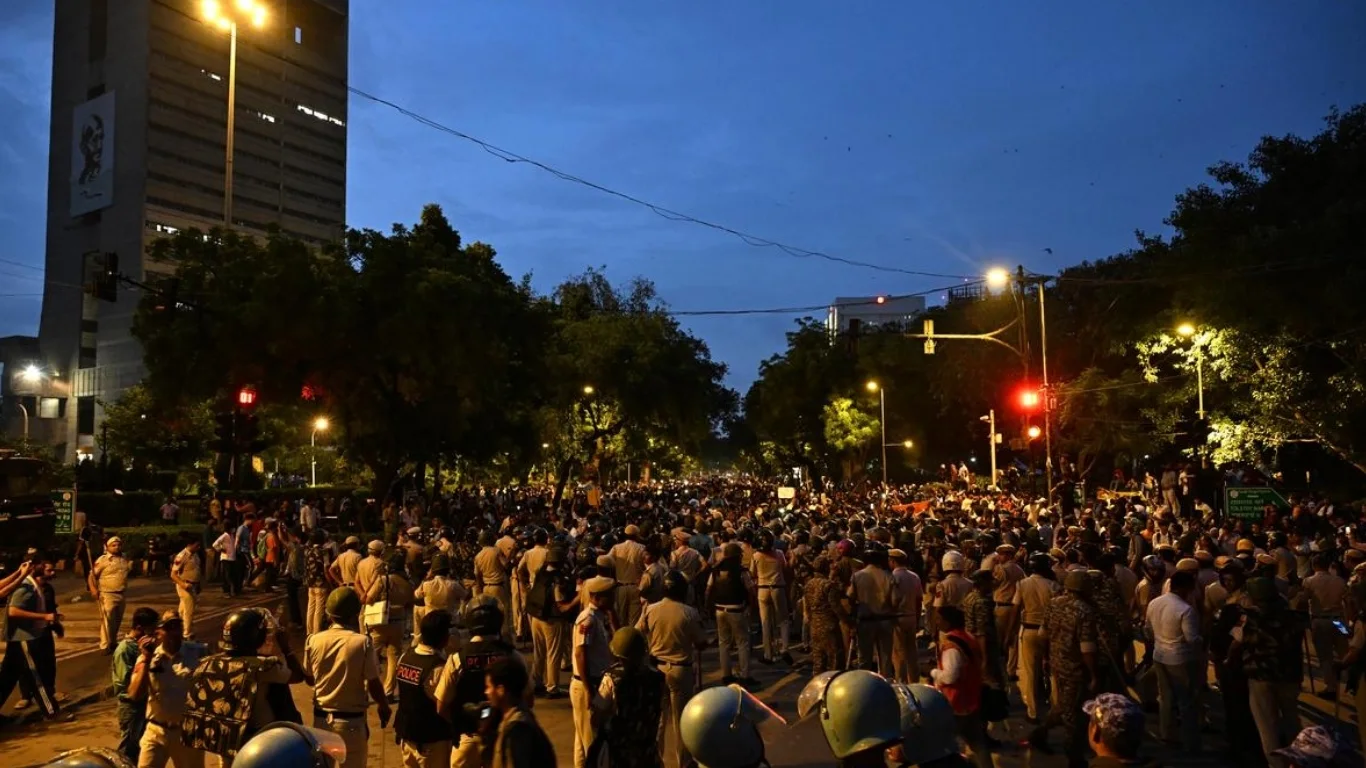
Delhi Police facial recognition system flagged nearly 2,900 people with criminal records during the CJP student protest
New Delhi: In late July 2026, Delhi Police released striking figures from the Cockroach Janta Party (CJP) protests at Jantar Mantar. Police used facial recognition systems on CCTV footage and mobile surveillance vans to scan the crowds. The system matched 2,873 faces with existing criminal databases.
Among them, 989 people had records linked to serious or heinous offences. The list included 101 people linked to murder cases, 61 linked to rape cases and six linked to offences under the Protection of Children from Sexual Offences (POCSO) Act. The remaining cases included robbery, dacoity, arms violations, narcotics offences and other crimes.
Police presented these figures as evidence that serious offenders had entered the student-led protest against the NEET-UG paper leak. The figures appeared in police reports submitted to the government, statements made in Parliament and an affidavit filed before the Supreme Court.
However, a later investigation by The Indian Express found major discrepancies in the most serious cases. At least 25 people whom the facial recognition system identified as being at the protest faced charges such as murder, rape, POCSO offences and attempt to murder. But prison records showed that these people were inside Tihar, Mandoli or Rohini jails on the same days when the system recorded them at Jantar Mantar.
The discrepancy has changed the focus of the controversy. What started as a claim about “criminals in the crowd” has now raised wider questions about how facial recognition works in Indian policing, how reliable police databases are and what risks arise when authorities use the technology at large public gatherings.
What Triggered the Protests
The Cockroach Janta Party emerged in mid-2026 as a satirical Gen-Z response to a remark by the Chief Justice of India comparing some unemployed young people to “cockroaches.”
The group soon moved beyond satire and focused on several public issues. These included the cancellation of the NEET-UG medical entrance examination after a paper leak, irregularities in other government examinations and demands for the resignation of Union Education Minister Dharmendra Pradhan.
Protesters began a continuous sit-in at Jantar Mantar around 20 June. The number of protesters increased as the agitation continued. Climate activist Sonam Wangchuk also joined the protest and began a hunger strike.
On 20 July, the movement attempted a “Chalo Sansad” march towards Parliament. Clashes broke out during the march. Police said more than 200 officers suffered injuries, while protesters claimed that more than 65 protesters were injured.
Videos circulated widely on social media and showed allegations of excessive force, including the use of pellet guns and incidents in which police officers allegedly struck women.
Pradhan resigned on 25 July. The CJP later called off its main agitation after talks that included commitments related to compensation for families of students who had died by suicide and the handling of FIRs.
However, the biometric data that Delhi Police collected during the protests continued to create controversy.
How the Facial Recognition Operation Worked
Delhi Police deployed several Facial Recognition System (FRS) units during the protests. These included the mobile “Ikshana” van, which carries high-resolution cameras and provides almost 360-degree coverage.
Police also used footage from fixed CCTV cameras around the protest area and other surveillance sources. The police then compared the images with two main databases: the Crime Kundli biometric database and criminal dossiers maintained at the district level.
According to police figures, the system found 2,402 matches through the Crime Kundli database and another 471 matches through district criminal dossiers. Together, these produced 2,873 matches.
Police classified 989 of those people as having serious or heinous criminal records. The detailed figures repeatedly mentioned in official briefings included:
- 101 people linked to murder cases, including 42 with two or more cases and 12 with 10 or more cases
- 62 people linked to attempt-to-murder cases
- 284 people linked to robbery or dacoity
- 61 people linked to rape cases
- 6 people linked to cases under the POCSO Act
- 25 people linked to molestation or outraging the modesty of a woman
- 229 people linked to cases under the Arms Act
- 135 people linked to snatching cases
- 67 people linked to cases under the NDPS Act
- 19 people linked to kidnapping cases
Delhi Police said the system focused only on people who already appeared in criminal databases. Police said they did not use it to profile ordinary protesters indiscriminately.
In an affidavit filed before the Supreme Court, police said a Special Investigation Team would investigate only people who had serious criminal charges. Police also said they would not pursue peaceful protesters outside the list of 2,873 people simply because of this facial recognition exercise.
The Investigation That Found People in Jail
The Indian Express examined a smaller group of 205 people from the police list. These people faced the most serious allegations, including murder, rape, POCSO offences and attempt to murder.
The newspaper compared their facial recognition records with prison, court and police records. The investigation found that at least 25 of them were in Delhi jails on the same dates when the FRS system recorded their faces at Jantar Mantar.
The investigation reported several specific examples.
Yogesh: Police described Yogesh as someone linked to organised crime networks and arrested him in connection with a 2024 murder. The facial recognition system recorded a face matching his at the protest site on the afternoon of 25 July. However, prison records showed that he remained inside his cell at that time.
Mustaq: The system flagged Mustaq at 6:31 p.m. on 24 July. Police accused him of murder and robbery. However, authorities had kept him in jail since 23 June.
Ankit Kumar: The system recorded Ankit Kumar at 5:58 p.m. on 24 July and linked him to a murder case. Prison records showed that he had remained in custody since 24 June.
The investigation found 17 people facing murder charges among those who could not have been present at the protest according to jail records. Several others faced rape or POCSO charges.
The system recorded these people at Jantar Mantar on different dates between 20 and 26 July.
An earlier Hindustan Times report also quoted a senior police officer who acknowledged that 22 of the identified people appeared in official records as being in custody during the protest period.
The officer suggested that some people could have received parole, furlough or medical leave and that authorities might not have updated every database immediately. However, the officer continued to maintain that video analysis and the facial recognition system had confirmed their presence.
Why the Mismatches Matter
Facial recognition systems do not simply give a yes-or-no answer about someone’s identity. Instead, they calculate how closely a face matches an image stored in a database.
Delhi Police have previously indicated that they treat matches above an 80% similarity threshold as positive.
However, several factors can affect the accuracy of facial recognition. These include poor or changing lighting, different camera angles, masks, movement, crowded locations and differences in camera quality.
The databases themselves can also create problems. They may contain old photographs, incomplete information about a person’s custody status or records that officials have not updated after a person’s arrest, release or transfer.
If a facial recognition system identifies people as being at a protest when prison records clearly show that they were behind bars, the problem goes beyond those individual cases.
First, the claim that those particular accused people attended the protest or took part in violence becomes difficult to support.
Second, the errors raise questions about the reliability of the wider list of 2,873 people.
Delhi Police have said that officers will not take action against anyone based only on an FRS match and that investigators will conduct further verification.
However, critics argue that police risk stigmatising an entire protest movement if they present raw facial recognition numbers to the government, Parliament and courts without first carrying out proper human verification.
Civil liberties groups and petitioners have already challenged the continuous surveillance at Jantar Mantar in the Delhi High Court. They argue that authorities need clear legal powers, privacy protections and safeguards before they can scan large groups of people who are exercising their right to protest.
India still does not have a dedicated, comprehensive law that specifically regulates the use of facial recognition technology by law-enforcement agencies.
Police Position and the Broader Context
Delhi Police maintain that facial recognition technology has become a standard tool for identifying wanted people and habitual offenders at large public gatherings.
Police have used the technology during events such as Republic Day celebrations, Independence Day events and major festivals.
According to the police, officers used the technology at Jantar Mantar as a preventive measure. They wanted to identify anti-social elements who could take advantage of the large crowd. Police also said the system helped them identify people with serious criminal records in and around a high-security area where violence had taken place.
Police also pointed to other crimes reported around the protest site during the same period. These included vehicle thefts, theft cases and reports of lost property. The force cited these incidents as further evidence that miscreants may have entered the protest area.
Delhi Police have rejected allegations that they indiscriminately “snooped” on peaceful protesters.
At the same time, independently checking every facial recognition match requires significant time and manpower. Police have indicated that investigators will conduct detailed checks only in a smaller group of serious cases.
The findings reported by The Indian Express show why that verification matters. Even within the group that police considered the highest priority, basic checks of prison records found significant errors.
What Remains Unresolved
Several important questions remain unanswered.
- How many of the remaining matches from the list of 2,873 people can investigators independently confirm through human review, multiple camera angles, video footage and updated custody records?
- What is the actual false-positive rate of the facial recognition system when authorities use it in a crowded outdoor protest?
- How long will authorities keep the biometric templates and facial recognition results collected during the agitation?
- Who can access this data, and what systems exist to audit that access?
- Will the Special Investigation Team treat facial recognition matches only as leads that require independent evidence, or will investigators treat them as almost conclusive proof of identity?
- How should courts assess police affidavits that rely heavily on automated facial recognition matches when later reporting shows clear contradictions with prison records?
The CJP protest achieved its main political demand after Pradhan resigned. But the biometric data collected during the agitation has opened a separate and much wider debate about how the state monitors public dissent.
Facial recognition technology can help police locate absconders, wanted criminals and history-sheeters. But the Jantar Mantar case also shows the risks that arise when the technology produces results that conflict with basic facts, such as whether a person was actually inside a prison.
The controversy highlights the need for stronger verification procedures, transparent accuracy data and clear legal limits on the use of facial recognition before authorities rely on the technology to interpret large public gatherings.
The cameras at Jantar Mantar recorded faces. The harder task now is to establish which faces actually belonged to the people identified by police databases — and to determine what those findings mean for both public safety and civil liberties.

Mansi Sharma is a journalist covering Global Affairs, and wellness, known for turning complex ideas into sharp, engaging narratives. Her work is driven by curiosity, depth, and a constant urge to question and explore. When she’s not writing, you’ll often find her diving into new ideas—preferably with a cup of coffee in hand, one sip at a time.