
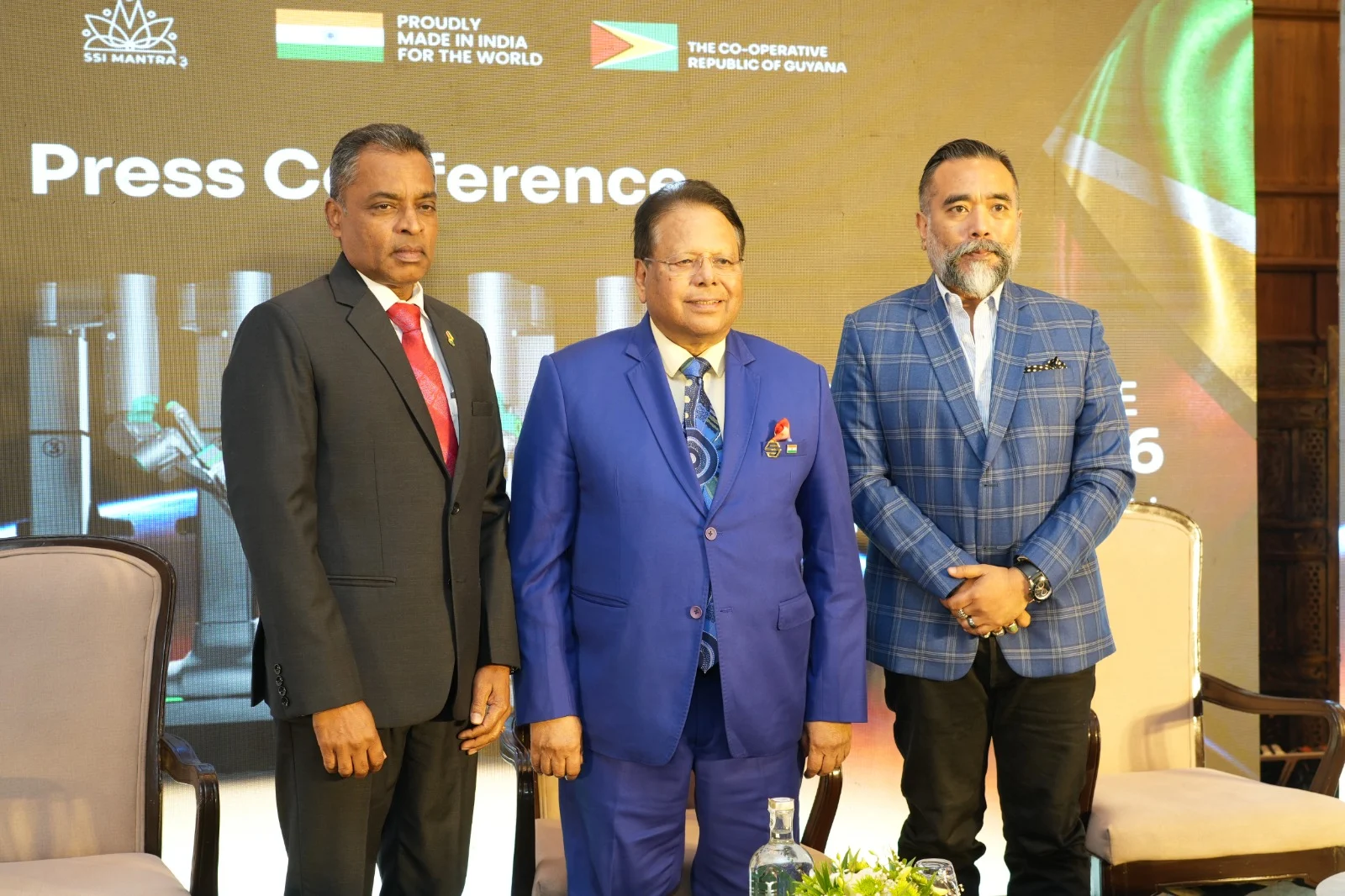
An Indian surgical robot set a world record by performing a heart surgery across 20,000 km, a breakthrough announced at a New Delhi press conference
New Delhi: Doctors and global health experts on Thursday announced a major breakthrough in telesurgery, revealing that an Indian-made surgical robot successfully performed a heart operation across a distance of nearly 20,000 kilometres — the longest ever recorded.
The announcement came during a press conference held at Taj Mansingh in New Delhi, where the surgical team and international representatives confirmed that the procedure has set a new global benchmark in remote robotic surgery.
The surgery was carried out on May 26, 2026, when cardiac surgeon Dr. Sudhir Srivastava operated from Georgetown, Guyana, on a patient in Indore, India. The procedure, a coronary artery bypass graft (CABG), was performed using the indigenously developed SSI Mantra 3 robotic system.
Experts stated that the system maintained a signal latency of under 150 milliseconds during the operation, ensuring real-time precision critical for cardiac procedures.
Key Facts
• Around 20,000 km distance between Guyana and Indore
• Less than 150 milliseconds signal delay during surgery
• Procedure: Coronary artery bypass graft (CABG)
• Robot used: SSI Mantra 3, India’s first CDSCO-approved telesurgery robot
• Date: 26 May 2026
• Renamed as “Mantra Freedom 60” by Guyana
• More than 150 telesurgeries performed using this system so far
A Record Built Over Time
This achievement did not happen overnight. The company behind the robot, SS Innovations, has steadily increased the distance of remote surgeries using its SSI Mantra 3 system.
They started with short distances: 40 km between Gurugram and Delhi, then 286 km to Jaipur, and later 2,000 km to Bengaluru. In July 2025, they performed the world’s first intercontinental robotic cardiac surgery between France and India, covering about 10,000 km.
In May 2026, they completed another 10,000 km surgery between Perth and Indore. Then came the 20,000 km milestone with Guyana.
Each surgery used fibre-optic connections and advanced low-latency technology. In heart surgery, even a tiny delay or error can be life-threatening, so speed and precision are critical.
Guyana’s Role in the Breakthrough
Guyana played a major role in this achievement. After the surgery, President Irfaan Ali spoke at a press conference in Georgetown and called it the longest-distance telesurgery ever attempted and completed.
The Guyanese government did more than just observe. It purchased the SSI Mantra 3 system, trained its medical team in India for two weeks, and established an international training centre in Guyana for the Caribbean region.
In a symbolic move, the country renamed the robot “Mantra Freedom 60” to celebrate its Diamond Jubilee year of independence.
At the same hospital, a local team led by Dr. Hemraj Ramcharran performed a robotic inguinal hernia surgery. He became the first surgeon in Guyana—and the English-speaking Caribbean—to operate using a robotic system. Although Dr. Srivastava guided the procedure remotely, the local team carried it out, showing that the technology had truly been transferred.
How the Technology Works
The SSI Mantra 3 is currently the only surgical robot approved specifically for telesurgery and remote training by India’s Central Drugs Standard Control Organisation (CDSCO).
The system converts the surgeon’s hand movements into real-time actions performed by robotic arms at the patient’s location. A high-resolution 3D video feed allows the surgeon to see the operation clearly, almost as if they are physically present.
The biggest challenge is latency, or delay. Any noticeable lag can be dangerous, especially in heart surgery. The system maintains a delay of less than 150 milliseconds, which is faster than the human blink reflex.
What Experts Said in New Delhi
At the press conference in New Delhi’s Taj Mansingh hotel, key experts presented the achievement. These included Dr. Sudhir Srivastava, Dr. Lalit Malik from Manipal Hospital Jaipur, and Dr. Mohit Bhandari, President of IRCAD India. Guyana’s Health Minister, Dr. Frank Anthony, joined virtually.
Dr. Malik explained that telesurgery is not a one-person effort. A trained team must stay with the patient to handle preparation, anaesthesia, instruments, and emergencies. The remote surgeon leads the operation, but the local team plays an equally important role.
Dr. Mohit Bhandari highlighted that this breakthrough removes distance as a barrier in healthcare. He said it represents a new model of global, patient-focused medical care.
He also pointed out its importance in medical training. Experienced surgeons can now guide less-experienced doctors in real time from anywhere in the world. This is especially useful in countries where specialists are concentrated in a few cities.
India’s Growing Role in Robotic Surgery
This achievement also shows India’s growing strength in medical technology. Before this, robotic surgery was dominated by expensive global systems, making it difficult for many hospitals in developing countries to afford.
The SSI Mantra system aims to change that. It is designed to be more affordable and suitable for regions with uneven infrastructure. So far, it has been used in over 90 types of surgeries and more than 150 telesurgeries.
The system has also received telesurgery approvals in countries like Indonesia and the Philippines. Approvals from the US FDA and European CE authorities were expected earlier, and the process is still ongoing.
Dr. Srivastava has consistently said that medical expertise should reach every patient, no matter where they live. This 20,000 km surgery shows that this vision is becoming a reality.
The historic heart surgery took place on 26 May 2026 using the SSI Mantra 3 robotic system. Experts shared full details at a press conference in New Delhi on 4 June 2026. The event brought together leading doctors and international representatives, marking a major step forward in global healthcare.
