
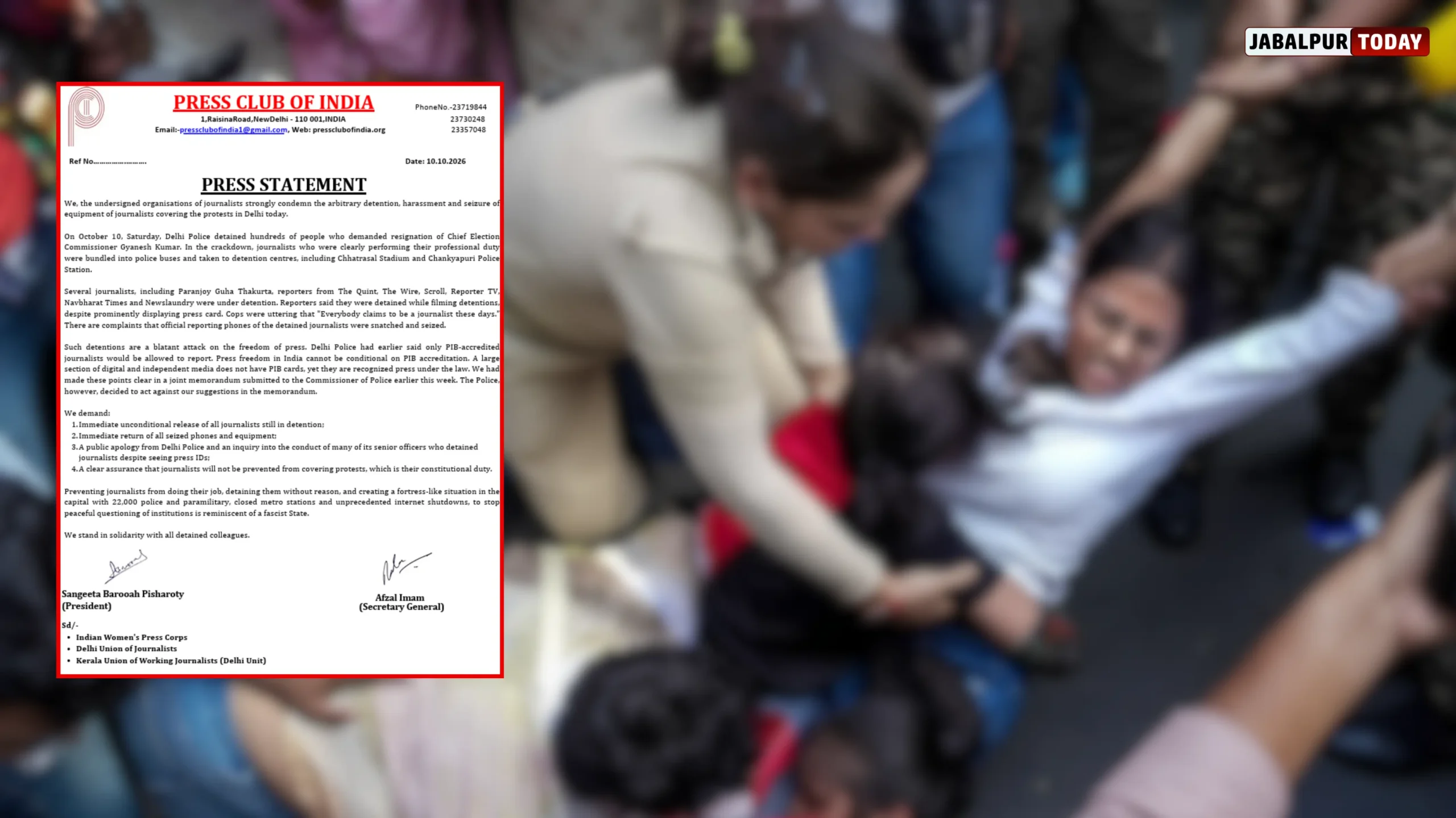
Delhi Police Detains Journalists Covering Anti-CEC Protests; Press Bodies Demand Release and Apology
New Delhi: Delhi Police detained hundreds of people on Saturday, including journalists covering protests demanding Chief Election Commissioner Gyanesh Kumar’s resignation. Press bodies condemned the detentions and accused police of harassing reporters and seizing their equipment.
The Press Club of India, Indian Women’s Press Corps, Delhi Union of Journalists and Kerala Union of Working Journalists (Delhi Unit) issued a joint statement. Press Club President Sangeeta Barooah Pisharoty and Secretary General Afzal Imam signed the statement. They called the action a “blatant attack on the freedom of press.”
Delhi Sees Heavy Security and Mass Detentions
Delhi Police deployed an estimated 20,000 to 22,000 police and paramilitary personnel across the capital. Authorities restricted access to dozens of metro stations, suspended mobile internet services in central areas and barricaded roads leading to Jantar Mantar.
The Cockroach Janta Party (CJP), a youth-led campaign, had called for a protest demanding Kumar’s resignation over alleged irregularities in the Special Intensive Revision (SIR) of electoral rolls. However, police denied permission, citing law-and-order concerns and procedural issues.
Despite the restrictions, people from Delhi and neighbouring states tried to reach the protest site. Police detained an estimated 2,000 to more than 3,500 people, while some reports cited higher figures. Officers took detainees to temporary holding centres, including Chhatrasal Stadium and Chanakyapuri Police Station.
Those detained included CJP founder Abhijeet Dipke and co-convenors Ashutosh Ranka and Saurav Das. Police took them into custody after their aircraft landed at Indira Gandhi International Airport. Officers also detained YouTuber Dhruv Rathee and opposition leaders, including Arvind Kejriwal, Mamata Banerjee, Pinarayi Vijayan and Manik Sarkar, when they tried to join or support the protests.
Journalists Detained Despite Showing Press Cards
Media organisations reported that police detained journalists even after they displayed their press cards and identified themselves.
Reporters from The Quint, The Wire, Scroll, Reporter TV, Navbharat Times and Newslaundry were among those detained. Newslaundry said police detained its reporters Ashwine Kumar Singh, Astha Savyasachi and Anmol Pritam, along with an intern. The organisation also alleged that officers seized their official reporting phones.
Some reporters claimed that police personnel dismissed their identity as journalists with remarks such as “Koi media nahin hai” (There is no media these days).
Scroll investigative reporter Ayush Tiwari said police detained him near ITO despite his showing his press card. Reports also named his colleague Shoaib Daniyal among those detained. Police took The Quint journalist Sarthak Jaiswal to Chanakyapuri Police Station and detained Navbharat Times reporters Hritik Joshi and Rahul Charas. Officers briefly detained a Reuters journalist before releasing the journalist.
Meanwhile, videos showed police personnel putting people on buses, including individuals holding up their press cards.
The Press Club of India said police had earlier announced that only journalists accredited by the Press Information Bureau (PIB) could cover the protest. However, many digital and independent media organisations do not hold PIB accreditation.
The Club said it had raised this concern in a memorandum to the Commissioner of Police earlier in the week. Nevertheless, it alleged that police “decided to act against our suggestions.”
Why Protesters Demanded Kumar’s Resignation
The protests centre on the Election Commission of India’s Special Intensive Revision of electoral rolls. Opposition parties, student groups and civil society organisations allege that the exercise has removed large numbers of voters from electoral lists in a way that disproportionately benefits the ruling Bharatiya Janata Party (BJP).
Opposition leaders and the CJP accuse Kumar of overseeing processes that undermine electoral integrity. They demand his resignation, the cancellation of the SIR exercise and greater transparency in voter-list management.
However, the Election Commission describes the revision as a routine verification exercise. It says eligible voters whose names do not appear on draft electoral rolls can apply for re-enrolment.
Protests against Kumar have grown over several weeks. Earlier demonstrations in Delhi and other cities also led to hundreds of detentions. Opposition MPs, including Leader of Opposition Rahul Gandhi, organised marches and sit-ins before October 10.
The CJP, which gained prominence after it pressured the education minister to resign earlier in the year, presented Saturday’s protest as a major show of strength.
Police Defend Security Measures
Police imposed restrictions across Delhi to prevent people from gathering at Jantar Mantar. Authorities also converted stadiums and other large facilities into temporary holding centres.
Officials cancelled or restricted some trains arriving in Delhi and set up checkpoints at entry points from neighbouring states. Police deployed anti-riot vehicles and Rapid Action Force units across sensitive areas. Meanwhile, internet restrictions affected residents and journalists trying to file reports.
A senior police officer said officers detained people who gathered in groups, raised slogans or actively participated in the protest. The officer added that police would examine each case involving media personnel individually.
“If a media person is found to have been genuinely carrying out journalistic duties, they will be released,” the officer said.
Police released several journalists later in the day. However, reports of seized phones and rough handling continued.
Media organisations challenged the police response because officers allegedly ignored press cards despite earlier instructions asking journalists to display them prominently.
Press Bodies Demand Release and Accountability
The Press Club of India condemned the detentions, stating, “Such detentions are a blatant attack on the freedom of press.” It added, “Press freedom in India cannot be conditional on PIB accreditation.”
The Club made four demands:
- Police must immediately and unconditionally release all detained journalists.
- Authorities must return all seized phones and equipment.
- Delhi Police must issue a public apology and investigate officers who detained journalists despite seeing their press cards.
- Authorities must guarantee that journalists can cover protests without interference.
The statement also warned that detaining journalists, restricting their work and imposing extensive security measures across Delhi created a situation “reminiscent of a fascist State.”
Similarly, the Committee to Protect Journalists (CPJ) urged police to release all detained journalists and media workers. It also demanded the return of their equipment, an investigation into reports of physical abuse and unrestricted media coverage of the protests and police response.
DIGIPUB News India Foundation and the National Alliance of Journalists also condemned the detentions. Both organisations demanded the release of those held and legal support for detainees.
Journalists Seek an Independent Inquiry
The Press Club of India and supporting organisations said they would continue to seek accountability. They also called for a formal inquiry into the conduct of officers involved in the detentions.
Police released some journalists and opposition leaders after holding them for several hours. However, press bodies continue to seek answers about the grounds for the detentions, the treatment of journalists in custody and the seizure of reporting equipment.
The organisations also want authorities to introduce safeguards that allow journalists to cover future protests without facing similar restrictions.
Crackdown Raises Concerns Over Press Freedom
Saturday’s events have raised concerns about the right to peaceful protest and journalists’ freedom to report from the capital. Critics argue that mass detentions, equipment seizures, barricades and internet restrictions threaten democracy and press freedom.
In contrast, supporters of the police action argue that authorities acted within their legal powers because organisers planned a large gathering without permission.
However, several questions remain. Why did police detain journalists who displayed their press cards? When will authorities return the seized equipment? Will an independent inquiry examine the police action? And will the incident further restrict space for dissent and independent journalism?
By late Saturday, reports indicated that many detained journalists had been released and had returned to work. However, the Press Club of India’s demands for a public apology and safeguards against future incidents remained unresolved.
Media organisations continue to verify the total number of journalists detained and the status of their equipment. The incident is also likely to fuel debate over the relationship between the state, the Election Commission and the media ahead of future elections.
