
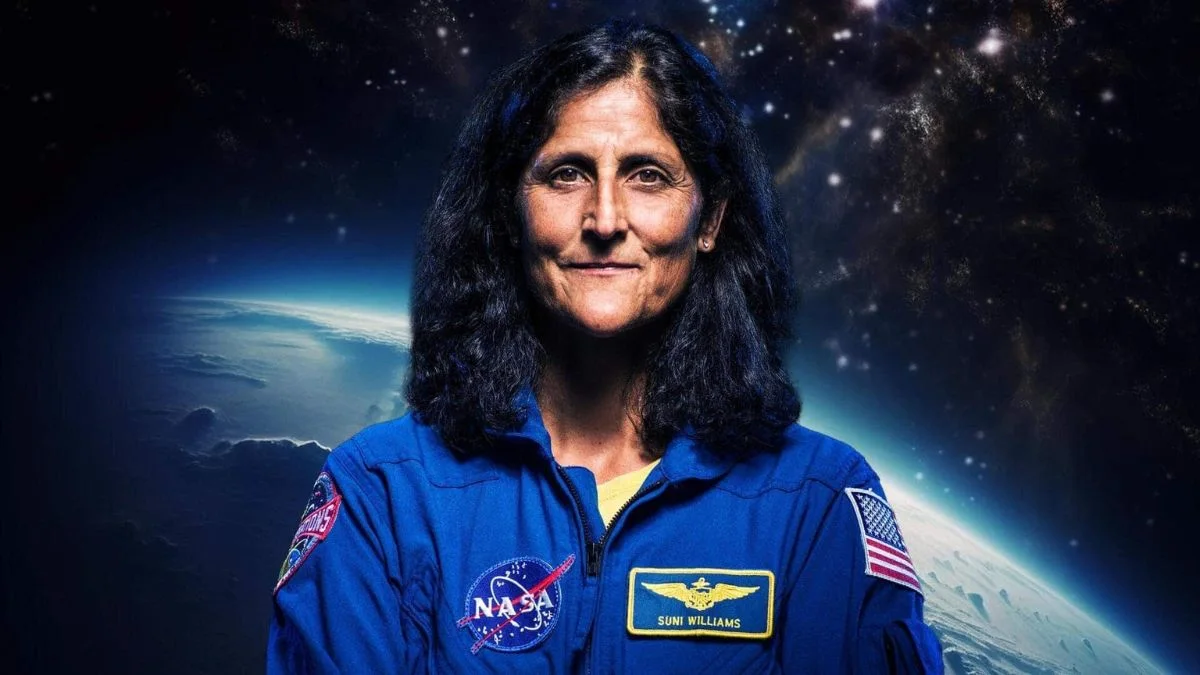
Sunita Williams turns 61 on September 19, 2026, marking her first birthday since retiring from NASA after a remarkable 27-year journey in space and service
New Delhi: September 19, 2026, marks Sunita Williams’ 61st birthday, but this birthday comes at a very different point in her life. After 27 years with NASA, three space missions and 608 days in space, Williams retired from the agency on December 27, 2025. For years, her name appeared alongside launches, spacewalks and International Space Station missions. This year, for the first time, the spotlight falls not on another mission but on the life she begins after NASA.
Sunita Williams turns 61 — her first birthday as a retired astronaut
A birthday often gives people a chance to stop and look at how far they have travelled. Williams has travelled farther than most people can imagine, but her story has always involved more than rockets and space stations.
Born in Euclid, Ohio, Williams grew up in Needham, Massachusetts, and later built a career through the U.S. Navy before joining NASA. She became an astronaut in 1998 and went on to fly three missions to the International Space Station.
Her latest mission ended in March 2025, when she returned to Earth aboard SpaceX’s Crew-9 Dragon after 286 days in space. NASA later announced her retirement, officially closing a 27-year career with the agency.
That makes her 61st birthday different. There is no upcoming NASA launch attached to it and no new mission waiting on the calendar. Instead, it marks a quieter transition after decades in which almost every major step came with intense preparation and a fixed mission schedule.
A 27-year NASA career comes to a quiet close
Williams joined NASA’s astronaut programme in 1998 as part of Astronaut Group 17. By then, she had already spent years developing the skills that would eventually take her into orbit.
Before NASA selected her, Williams served as a U.S. Navy pilot and test pilot. She worked with different aircraft and gained extensive flight experience before moving into astronaut training.
Her NASA career also involved much more than flying into space. She worked in astronaut operations, supported training and took on responsibilities connected to future human spaceflight. NASA’s January 2026 biography identifies her as a retired U.S. Navy captain and veteran of three space missions.
Her retirement therefore closes a much larger professional journey than simply her time aboard the International Space Station.
The mission that turned an ordinary test flight into a global story
Williams’ final mission began on June 5, 2024, when she and NASA astronaut Butch Wilmore launched aboard Boeing’s Starliner for its first crewed flight.
NASA originally planned the test flight to last about eight to 14 days. Technical problems involving the spacecraft’s propulsion system changed that plan. NASA eventually decided to bring Starliner back without its crew, while Williams and Wilmore remained aboard the International Space Station as part of Expeditions 71 and 72.
They returned to Earth on March 18, 2025, aboard SpaceX’s Crew-9 Dragon. Their final mission lasted 286 days, far longer than the original test-flight plan. NASA says Williams and Wilmore completed 4,576 orbits of Earth and travelled more than 121 million miles during that mission.
During those extra months, Williams continued station work, research, exercise and other daily responsibilities. The mission became one of the most closely followed chapters of her career, but inside the station, she still had a job to do.
What she leaves behind: records are only one part of the story
Williams leaves NASA with a remarkable record, but the numbers do not fully explain why her career became so memorable.
NASA records show that she spent 608 days in space across three missions, placing her second among NASA astronauts for cumulative time in space at the time of her retirement. She completed nine spacewalks, spending 62 hours and six minutes outside the station. That remains the highest cumulative spacewalking time recorded by a woman astronaut.
She also became the first person to complete a marathon in space. In 2007, she ran the Boston Marathon on a treadmill aboard the International Space Station while moving around Earth at orbital speed.
Williams commanded the International Space Station during Expedition 33 in 2012 and again during Expedition 72 in 2025. NASA also identifies her as the first woman to fly on a crewed test flight of a new orbital spacecraft through the Starliner mission.
These records will remain part of her legacy. But her career also showed what happens when preparation, patience and adaptability meet opportunities that few people ever receive.
A life shaped by Indian, Slovenian and American roots
Williams’ story also connects several cultures.
She was born Sunita Lyn Pandya in Ohio. Her father, Dr Deepak Pandya, had Indian roots, while her mother, Bonnie Pandya, came from a Slovenian background. Williams grew up with both sides of that family heritage while building her own identity as an American.
Her Indian heritage has made her especially recognisable to audiences in India and among Indian-American communities. At the same time, it is important to describe her accurately: Williams is an American astronaut of Indian and Slovenian descent, not an Indian citizen.
Her family background became part of her public story, but it never defined the limits of her career. Her professional path grew from her own interests, education, military service and years of training.
From the Naval Academy to the International Space Station
Williams did not grow up knowing that she would become an astronaut.
As a young person, she reportedly considered becoming a veterinarian. Instead, she entered the U.S. Naval Academy and graduated in 1987 with a degree in physical science. She later became a naval aviator and test pilot before NASA selected her as an astronaut.
Her aviation experience prepared her for the discipline of spaceflight. She flew different types of aircraft and worked in demanding environments long before she ever left Earth. NASA’s records also show that she later became involved in astronaut-office operations and other work supporting human spaceflight.
Her path therefore did not follow a straight line from childhood dream to astronaut. It developed step by step.
What retirement might look like for someone who ran a marathon
Retirement can look very different after a career built around mission plans, training schedules and launch dates.
There is limited confirmed public information about Williams’ day-to-day life after NASA, and it would be unfair to fill that gap with speculation. What is known is that NASA has previously described her interests outside work as including exercise, hiking, camping and time spent with her husband and dogs.
For Williams, retirement also means leaving behind the constant rhythm of astronaut life. She no longer needs to prepare for another launch or spend months training for a specific mission.
That change may sound simple, but after decades at NASA, it represents a major shift. Her next chapter does not need to involve another record to have meaning.
Why her story still matters to a new generation
Williams’ influence will continue even though she has left NASA.
Young people can look at her journey and see that an astronaut career does not always begin with an obvious plan. Williams first considered veterinary medicine, entered the Navy, became a pilot and test pilot, joined NASA and eventually commanded the International Space Station.
Her story also carries significance for people who rarely saw someone with a similar family background represented in space exploration.
Her name often appears in conversations about prominent astronauts of Indian heritage, alongside Kalpana Chawla. Their lives and careers followed very different paths, but both became important figures for generations who watched South Asian representation grow in human spaceflight.
NASA has also highlighted Williams’ role as a leader whose work can inspire future explorers.
At 61, her story no longer needs another launch to remain relevant. The example she leaves behind already reaches beyond the International Space Station.
Her Next Chapter Begins Here
Sunita Williams’ 61st birthday marks more than another year in the life of a celebrated astronaut. It marks her first birthday after closing a 27-year NASA career and beginning a chapter whose details will belong more to her than to a mission schedule.
After spending 608 days looking at Earth from space, Williams now celebrates another birthday on the planet she spent so much of her career studying, protecting and returning to.
