
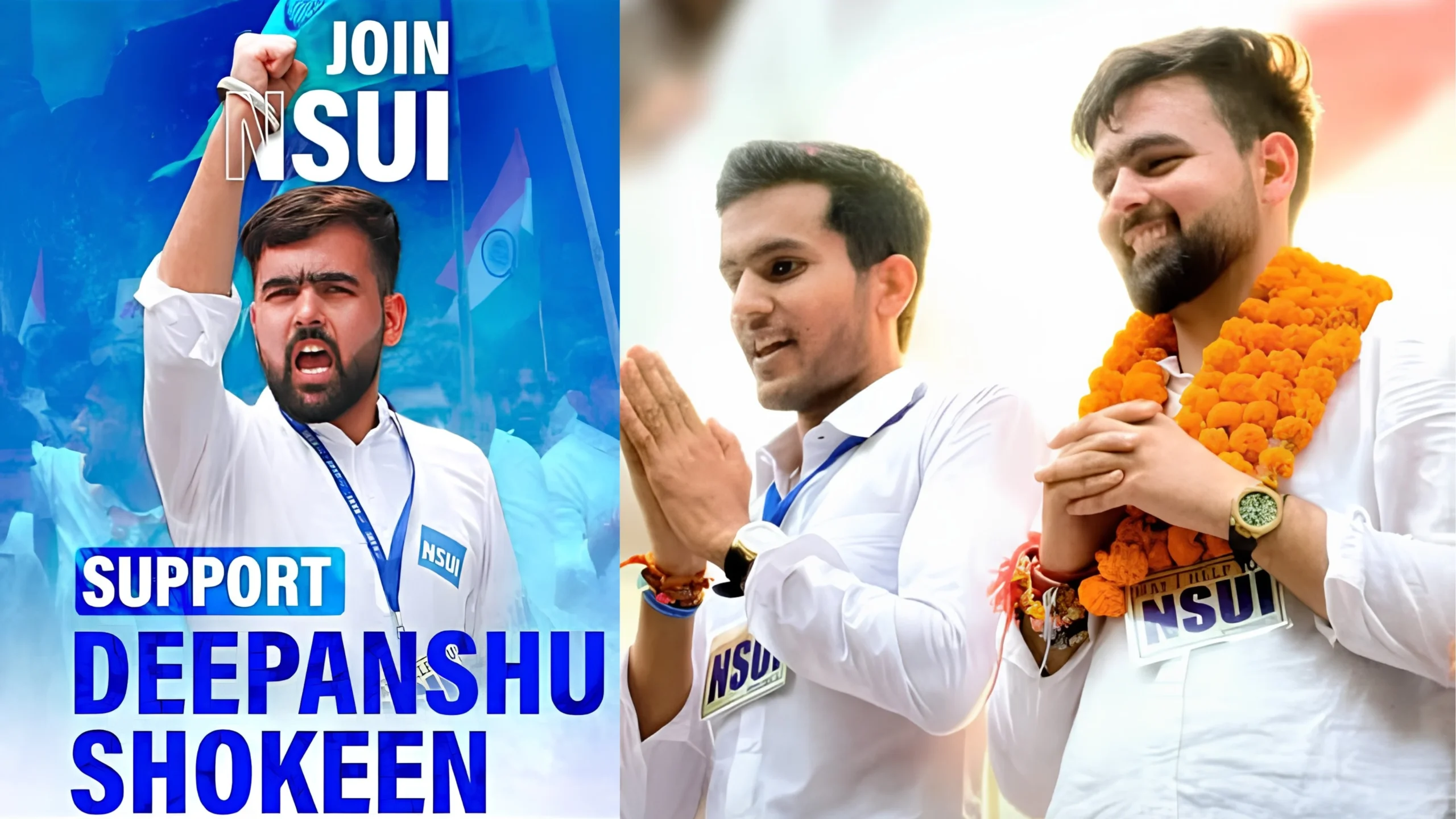
From four years with NSUI to an independent DUSU bid, Deepanshu Shokeen has put student safety, housing and representation at the centre of his campaign
New Delhi: As Delhi University entered election mode this September, one name stood out amid car rallies, party flags and slogan wars: Deepanshu Shokeen. Shokeen is contesting the Delhi University Students’ Union (DUSU) election 2026 as an independent candidate for Vice President. His entry has added another layer to a contest that has traditionally centred on two major student organisations — the RSS-backed ABVP and the Congress-affiliated NSUI.
Students voted across Delhi University on September 18, 2026, while the university scheduled vote counting for September 19. More than 1.5 lakh students are eligible to vote this year.
In the days before voting, Shokeen’s yellow banners, marigold garlands and regular social-media reels made him a familiar face on campus. Students saw his campaign around North Campus and on social media and began asking the same question: Who is this independent candidate, and why has he become so visible?
From NSUI activist to independent candidate
Deepanshu Shokeen studies at the Department of Buddhist Studies at the University of Delhi. He comes from the Jat community and has roots in Delhi’s Nangloi Jat area. He has spent around four years working in student politics, mainly with the NSUI.
In 2025, students already knew Shokeen as an NSUI-linked face. He appeared in long-form podcasts and pre-campaign videos as a possible NSUI presidential aspirant. During those appearances, he spoke about student issues, the influence of national politics on campus and the experiences of students at North and South Campus colleges.
This year, however, his political path changed.
NSUI announced its official panel with Vijay Shankar Meena as President, Vir Chatrath as Vice President, Namrata Chaudhary as Secretary and Gopal Choudhary as Joint Secretary. Shokeen did not get a place on the panel.
He then entered the election as an independent candidate after disputes over ticket distribution. Vishesh Yadav also entered the contest as an independent candidate for Joint Secretary. The university’s provisional candidate list placed Shokeen among the five candidates contesting for Vice President, with the Department of Buddhist Studies listed against his name and Ballot No. 2.
DUSU has seen similar rebellions before. In 2025, Umanshi Lamba, who had links with NSUI, contested the presidential election as an independent after she did not receive a party ticket. She received 5,522 votes. Her campaign showed how an independent candidate with links to a major student organisation can still attract a sizeable section of voters.
Shokeen’s decision has therefore raised questions among party workers about whether his campaign could divide votes that might otherwise go to the NSUI panel.
His father joins the campaign trail
Another feature of Shokeen’s campaign has attracted attention: his father’s visible presence on the campaign trail.
The father-son combination has become part of Shokeen’s campaign image. At colleges such as Rajdhani, his campaign has attracted students with yellow banners and garlands instead of relying only on the large campaign machinery associated with major student organisations.
Shokeen has repeatedly described himself as the “voice of the common student”. In interviews, he has spoken about the four years he spent among students and the support he built through regular interaction on campus.
He says he wants to represent everyday student concerns rather than organisational equations.
After the Satya Niketan PG building collapse, which killed several DU students, Shokeen linked his campaign to demands for justice and compensation for the victims’ families. He described the incident as a failure of accountability and argued that students should not forget the issue once the election season begins.
The larger DUSU election battle
Shokeen’s campaign becomes easier to understand when we look at the wider DUSU election.
For years, ABVP and NSUI have dominated the DUSU presidential contest. Community equations have also played an important role in campus politics.
From 2010-11 to 2025-26, every DUSU president came from either the Jat or Gurjar community. ABVP won the presidency nine times during that period, mostly with Gurjar candidates, while NSUI won four times, all with Jat candidates.
This year, however, NSUI changed its approach. The organisation fielded Vijay Shankar Meena, an Adivasi student from Rajasthan and a first-generation learner studying Buddhist Studies, for President.
ABVP fielded Yash Dabas, an international-level tennis player who also studies at the Department of Buddhist Studies.
The 2026 election has also brought several other candidates into the spotlight. AISA and SFI have joined hands for a common panel. ASAP has fielded a visually impaired candidate. Other independent candidates have also entered the contest.
The field includes sports personalities, a student from Ladakh, a visually challenged candidate, literary society members and former members of major student organisations who decided to contest independently. The final list includes 20 candidates across the four central posts.
In this setting, Shokeen’s independent campaign has added another dimension to the traditional ABVP-NSUI contest. His presence both online and on campus has made him a regular topic of discussion among students.
What does Shokeen stand for?
Shokeen has focused his campaign mainly on student issues rather than party ideology.
His campaign has highlighted the shortage of safe and affordable hostels and PG accommodation, student safety, especially for women, infrastructure problems and accountability after incidents such as the Satya Niketan building collapse.
Paper-leak protests and tensions between students and the administration have also shaped the campus environment.
Shokeen presents himself as a candidate who does not have to follow a party line. This approach allows him to focus his campaign on issues that affect students in their daily lives.
His supporters point to the network he built during four years of campus activity. They say his presence among students goes beyond a formal party organisation.
Rival groups, on the other hand, argue that independent candidates can divide votes without securing a victory. Both views have become part of the election discussion.
What remains clear is that Shokeen has attracted considerable attention. Media reports, campus interviews and social-media discussions have repeatedly raised questions about whether an independent candidate can win a central-panel post, how much support he could draw from former NSUI voters and whether his campaign reflects dissatisfaction over ticket distribution inside student organisations.
Why does Buddhist Studies matter?
The Department of Buddhist Studies has played a noticeable role in DUSU politics.
The department has a relatively large student intake and includes many politically active postgraduate students. This has made it a regular source of candidates for major student organisations.
Several candidates from both ABVP and NSUI are studying at the department this year.
Shokeen’s name on the independent list continues that trend but adds a different element. He worked within a major student organisation for years and now contests the election outside its official panel.
DUSU elections remain among India’s most prominent student political contests. In recent years, turnout has remained in the high 30s to around 40 per cent of the eligible electorate. This year, more than 1.5 lakh students can vote.
The election also gives ABVP and NSUI an opportunity to assess their organisational strength. At the same time, the results contribute to wider discussions around youth politics, community mobilisation and the ability of national political parties to manage their student organisations.
Election day and what happens next
Students voted on September 18, with Shokeen contesting alongside the official candidates and other independents. The Vice President’s race includes Ishu Maurya from ABVP, Vir Chatrath from NSUI, Akshat Shikhar from the AISA-SFI alliance, Aranya Singh Rathore and Deepanshu Shokeen.
The university has scheduled vote counting for September 19.
The results will show whether Shokeen’s independent campaign converts its visibility into a significant vote share or remains a symbolic challenge to the established student organisations.
His campaign has already highlighted several features of present-day campus politics: the impact of ticket distribution, the strength of personal networks built through years of student activity, the continued role of community identity and the demand among some students for candidates who operate outside traditional party structures.
For a DU student following the election, a parent trying to understand the campus politics or an observer tracking student politics in India, Shokeen’s story offers a wider view of the pressures shaping DUSU.
He spent several years working with NSUI but did not receive a place on its official panel. Then He also chose to contest independently. He brought his father into the campaign, focused on student safety and accommodation after a deadly building collapse, and combined traditional campus campaigning with social-media outreach.
Through this campaign, he has added an independent voice to an election that has traditionally received most attention for the ABVP-versus-NSUI contest.
The final results will decide the electoral outcome. However, the questions around representation, ticket distribution within student organisations and the space for independent candidates on campus will continue to remain part of the wider discussion around DUSU.

Mansi Sharma is a journalist covering Global Affairs, and wellness, known for turning complex ideas into sharp, engaging narratives. Her work is driven by curiosity, depth, and a constant urge to question and explore. When she’s not writing, you’ll often find her diving into new ideas—preferably with a cup of coffee in hand, one sip at a time.