
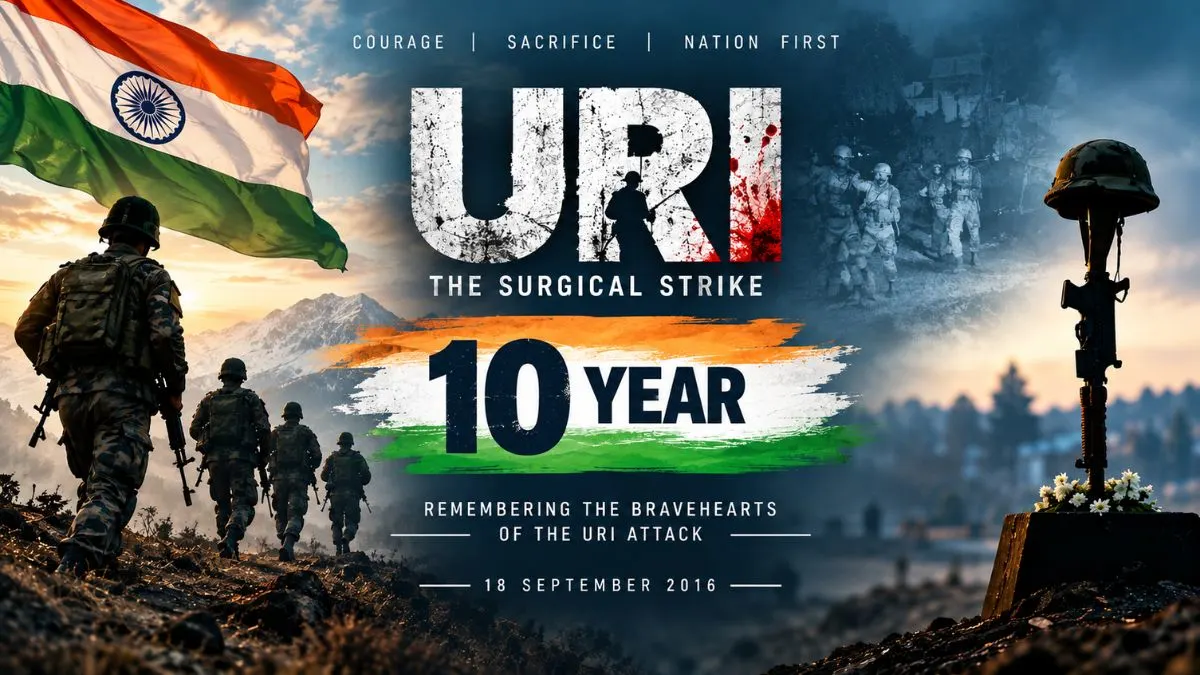
10 years after the Uri attack, India remembers the soldiers killed on September 18, 2016, and the surgical strikes that followed 11 days later
New Delhi: September 18, 2026, marks 10 years since the Uri attack, when four terrorists struck an Indian Army base in Jammu and Kashmir in the early hours of the morning. The 2016 attack killed several soldiers and became one of the most significant terror attacks on an Army installation in the country at the time. Eleven days later, India announced that its Special Forces had carried out surgical strikes across the Line of Control. The Uri attack and the response that followed marked a significant shift in how India publicly addressed cross-border terrorism.
What happened in the Uri attack on September 18, 2016?
The Uri terror attack began at around 5:30 AM on September 18, 2016. Four heavily armed terrorists entered an Indian Army administrative base near Uri in the Baramulla area of Jammu and Kashmir, close to the Line of Control.
The Indian Army said the attackers were suspected to belong to Jaish-e-Mohammed (JeM). They used automatic weapons, grenades and incendiary ammunition during the attack.
The base had more troops than usual because two infantry units were going through a routine changeover. Some soldiers stayed in temporary tents and shelters. The attackers’ incendiary ammunition set several of these structures on fire, adding to the casualties. The Army later recovered AK-47 rifles, grenade launchers and other material from the four attackers.
Uri attack 2016: How did the attack unfold?
The attack started at approximately 5:30 AM. The terrorists opened fire and threw grenades as Army personnel responded.
The firefight continued for several hours. According to the Army’s account issued on September 18, three of the four attackers were killed within the first 15 minutes after contact, while soldiers later eliminated the fourth attacker. The operation continued until around 8:30 AM.
Army personnel then searched the military complex and surrounding area to make sure no further attackers remained. The Army formally called off the clearance operation after a detailed search on September 19.
Uri attack death toll: How many soldiers died?
The Uri attack death toll changed as authorities received updates on the condition of injured soldiers.
The Army initially reported 17 soldiers killed on September 18. Later reports put the immediate toll at 18, while the number eventually reached 19 after critically injured soldiers died during treatment. Official and media accounts therefore recorded different numbers depending on when they reported the casualties.
The important point is that the attack caused the deaths of many soldiers and left several others injured. Contemporary reports placed the number of injured soldiers between roughly 19 and 30.
The changing death toll should therefore be read in its timeline rather than treated as a contradiction in the historical record.
Which Army unit suffered the biggest loss?
Many of the soldiers killed in the Uri Army base attack belonged to the 10th Battalion of the Dogra Regiment.
The soldiers were staying in temporary shelters because of the ongoing unit changeover. The fires caused by the attackers’ incendiary ammunition trapped several troops inside the tents and shelters. The Army said 13 to 14 of the initial casualties resulted from the fires.
Uri attack soldiers: Roll of honour
The soldiers named in the supplied roll of honour are:
Subedar K Singh; Havildar N S Rawat; Havildar R Paul; Havildar A Kumar; Naik S K Vidarthi; Lance Naik R K Yadav; Lance Naik G Shankar; Sepoy G Shankar; Sepoy K V Janardhan; Sepoy G Dalui; Sepoy R Singh; Sepoy N Kujur; Sepoy U Janrao; Sepoy R K Singh; Sepoy H Yadav; Sepoy B Ghorai; Sepoy T S Somnath; Sepoy J Munda.
These names remain part of the remembrance associated with the Uri attack anniversary.
What happened in the 11 days after the Uri attack?
The days after the attack saw heightened security along the Line of Control and a focus on preventing further infiltration.
On September 19, the Army said it had maintained restraint while dealing with the situation but also retained the ability to respond at a time and place of its choosing.
Eleven days after the Uri attack, India announced that its Special Forces had conducted an operation across the Line of Control.
Surgical strikes 2016: What happened on September 29?
On the night of September 28-29, 2016, Indian Army Special Forces carried out what India called surgical strikes against suspected terrorist launch pads across the Line of Control.
Then Director General of Military Operations Lt Gen Ranbir Singh announced the operation on September 29. He said the Army had received specific and credible information about terrorist teams positioned at launch pads and preparing to infiltrate Jammu and Kashmir and carry out attacks in other parts of India.
The operation became closely associated with the Uri attack and surgical strikes of 2016. Indian government accounts have since described the strikes as an important milestone in the country’s counter-terrorism strategy.
What was Pakistan’s response to the surgical strikes?
Pakistan’s official response disputed India’s account of the operation.
Pakistan’s military described the incident as cross-border firing rather than the surgical strikes announced by India. Pakistani officials said two of its soldiers were killed and nine were injured.
The two countries therefore presented different accounts of what happened across the Line of Control on the night of September 28-29, 2016.
Why did the Uri attack become a turning point?
The Uri attack 2016 became significant not only because of the loss of soldiers but also because of India’s response.
India publicly announced a cross-LoC military operation for the first time in this manner. Later government assessments described the September 2016 surgical strikes as a milestone in India’s counter-terrorism strategy and as part of a more proactive approach towards cross-border terrorism.
The Uri attack and the response that followed therefore became an important reference point in discussions about India’s military and counter-terrorism posture.
Uri attack anniversary: Remembering the soldiers
Ten years after the Uri terror attack, the focus of the anniversary remains the soldiers who lost their lives.
The attack changed the lives of their families forever. While the military and political developments that followed became part of India’s security history, the soldiers who died at Uri remain at the heart of the September 18 remembrance.
Their names continue to be remembered with respect, and their sacrifice remains a solemn part of the Indian Army’s history.
September 18 is not only a date in India’s security timeline. It is also a day to remember the soldiers who did not return home and the families who continue to carry their memory.
