
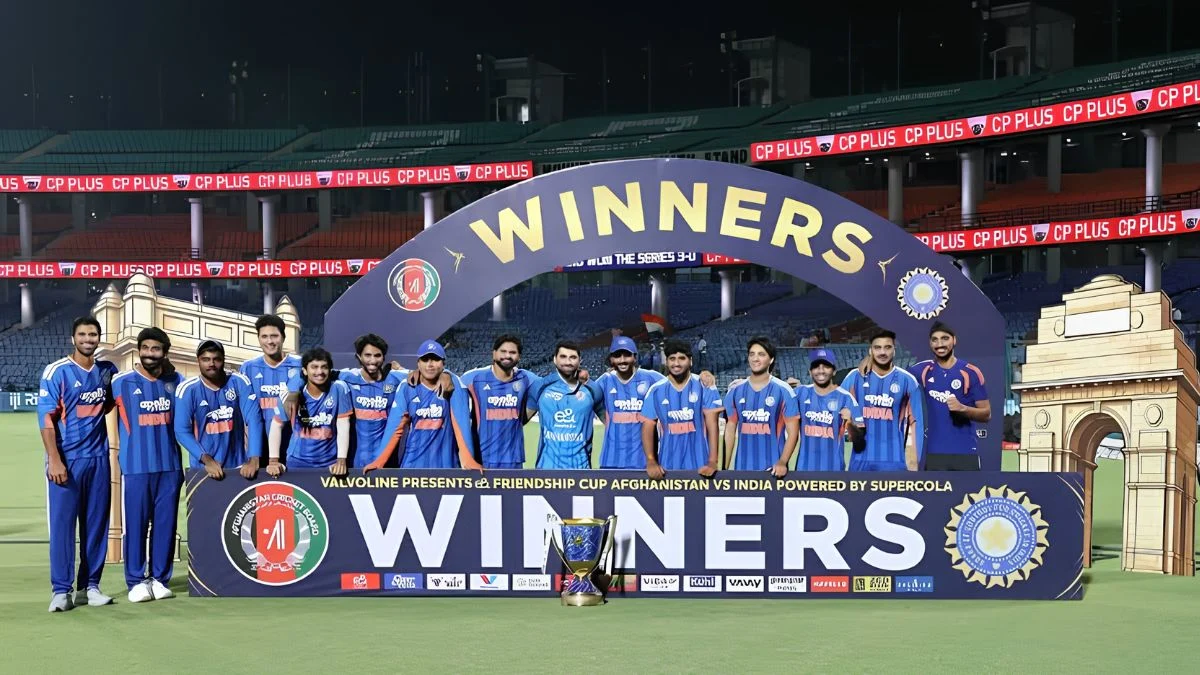
Abhishek Sharma powered India to a 3-0 sweep in the India-Afghanistan Friendship Cup as a record 30-ball century sparked a night of historic T20I milestones
New Delhi: Delhi witnessed a record-breaking finish to the India-Afghanistan Friendship Cup as India completed a 3-0 T20I series sweep on September 17, 2026. Abhishek Sharma stole the show with a stunning 30-ball century, powering India to 221/7 before Afghanistan collapsed for 94. The 127-run win produced a string of historic milestones, from the fastest T20I century by a Full Member batter to India’s biggest T20I win over Afghanistan.
Here are the top 8 records that were broken or matched during a remarkable night at the Arun Jaitley Stadium.
The fastest century by any Full Member nation batter
Abhishek needed only 30 balls to reach his century, making it the fastest T20I hundred ever scored by a batter from a Full Member nation. In cricket, Full Members are the ICC’s top member nations that hold Test status.
The previous joint record stood at 33 balls. Zimbabwe’s Sikandar Raza reached that mark against Gambia in 2024, while New Zealand’s Finn Allen matched it against South Africa at the 2026 T20 World Cup.
Abhishek’s hundred also sits third on the overall list for fastest men’s T20I centuries. Estonia’s Sahil Chauhan still holds the global record with his 27-ball hundred against Cyprus in 2024, while Turkey’s Muhammad Fahad reached three figures in 29 balls against Bulgaria in 2025.
Abhishek began even faster than the century record suggests. He reached his fifty from 16 balls and needed only 14 more deliveries to turn it into a hundred.
His final score read 108 from 34 balls, with a strike rate of 317.65. That became the highest strike rate recorded by an Indian batter in a T20I century.
How it compares to Rohit Sharma’s old Indian record
For Indian cricket, the record had belonged to Rohit Sharma for nearly nine years. Rohit reached his T20I century from 35 balls against Sri Lanka in 2017.
Abhishek cut five balls from that mark.
The left-hander also completed another milestone during his extraordinary innings. This was his third T20I century, while only Rohit Sharma, with five, and Suryakumar Yadav, with four, have more hundreds for India in the format.
Even more strikingly, Abhishek became the first batter to score two T20I centuries in fewer than 40 balls.
A powerplay for the ages
Abhishek did not wait until the middle overs to take control. He scored 76 runs from just 22 balls during the powerplay, the first six overs of a T20 innings.
That became the highest individual score by any batter in the powerplay in men’s T20I history.
India also crossed 100 without losing a wicket by the end of those six overs. That gave them their highest-ever T20I powerplay score. Sanju Samson provided the other half of India’s explosive start as the opening pair turned the first six overs into a scoring sprint.
The match had technically become a dead rubber, meaning the series result was already decided before the final game. India had taken an unassailable 2-0 lead in the first two matches. Yet the final game produced anything but a low-key finish.
Nearly every run in boundaries
Abhishek’s 108 came with nine fours and 11 sixes. That means 102 of his 108 runs came from boundaries, leaving only six runs from running between the wickets.
His 11 sixes also gave him the second-most sixes by an Indian batter in a single T20I innings. The combination of power and speed explained why his century arrived before the halfway point of India’s innings.
The scale of India’s total at Arun Jaitley Stadium
India eventually finished on 221/7 from their 20 overs. The score equalled their highest-ever T20I total at the Arun Jaitley Stadium.
It also became the second-highest T20I total ever recorded against Afghanistan. India had already put Afghanistan under pressure during the opening six overs, and the final total ensured the visitors faced an enormous chase.
Abhishek’s century formed the centrepiece, but India kept scoring after his dismissal. Samson added another fifty, while the middle order carried the team beyond the 200-run mark.
Afghanistan’s historic collapse
Afghanistan never found a way back into the contest after the early damage. The visitors folded for 94, their lowest-ever T20I total against India.
Their spinners, including Rashid Khan and Qais Ahmad, also struggled to slow India’s scoring, conceding more than nine runs an over combined.
The chase started with some intent, but India’s bowlers quickly removed Afghanistan’s top order. The pressure kept building, and the innings eventually ended in the 15th over.
India’s biggest-ever win over Afghanistan by runs
India’s 127-run victory set another major mark. Afghanistan had never previously lost a T20I by such a large margin.
The previous record stood at 116 runs, set by England in 2012.
The 127-run margin also reflected how completely the match changed after India’s powerplay assault. Afghanistan lost wickets regularly while the required scoring rate kept climbing, leaving the visitors with little room to recover.
Where this fits among India’s dominant wins
The result also moved India into another statistical landmark. This was India’s 10th T20I victory by 100 or more runs.
That figure equals the record for the most such wins by any team. India now share that mark with Canada.
The 127-run victory therefore added another major entry to India’s list of big T20I wins, while the 3-0 sweep gave them another clean series result at home.
India have now won 11 of their last 12 home T20I series, underlining how consistently they have converted home conditions into series victories.
The bigger pattern: Abhishek’s rise this year
The Delhi hundred did not arrive in isolation. Abhishek had already opened this series with 82 and followed it with 39 in the second T20I. He entered the final match having made a strong impact across the series, then produced the biggest innings of the three.
His 2026 campaign has now included multiple explosive T20I performances, and this latest innings pushed his record-breaking ability to another level. He has also shown that his aggression does not depend on a long stay at the crease: 16 balls took him to fifty, and another 14 took him to a record century.
For India, the sweep offers a strong finish before the team moves on to the Asian Games campaign. For Abhishek, September 17 will stand out as the night he turned a series finale into a piece of T20I history.
The numbers from Delhi tell the story: 30 balls for the century, 100 runs in the powerplay, 221/7 for India and a 127-run victory.
And at the centre of all of it stood Abhishek Sharma.
