
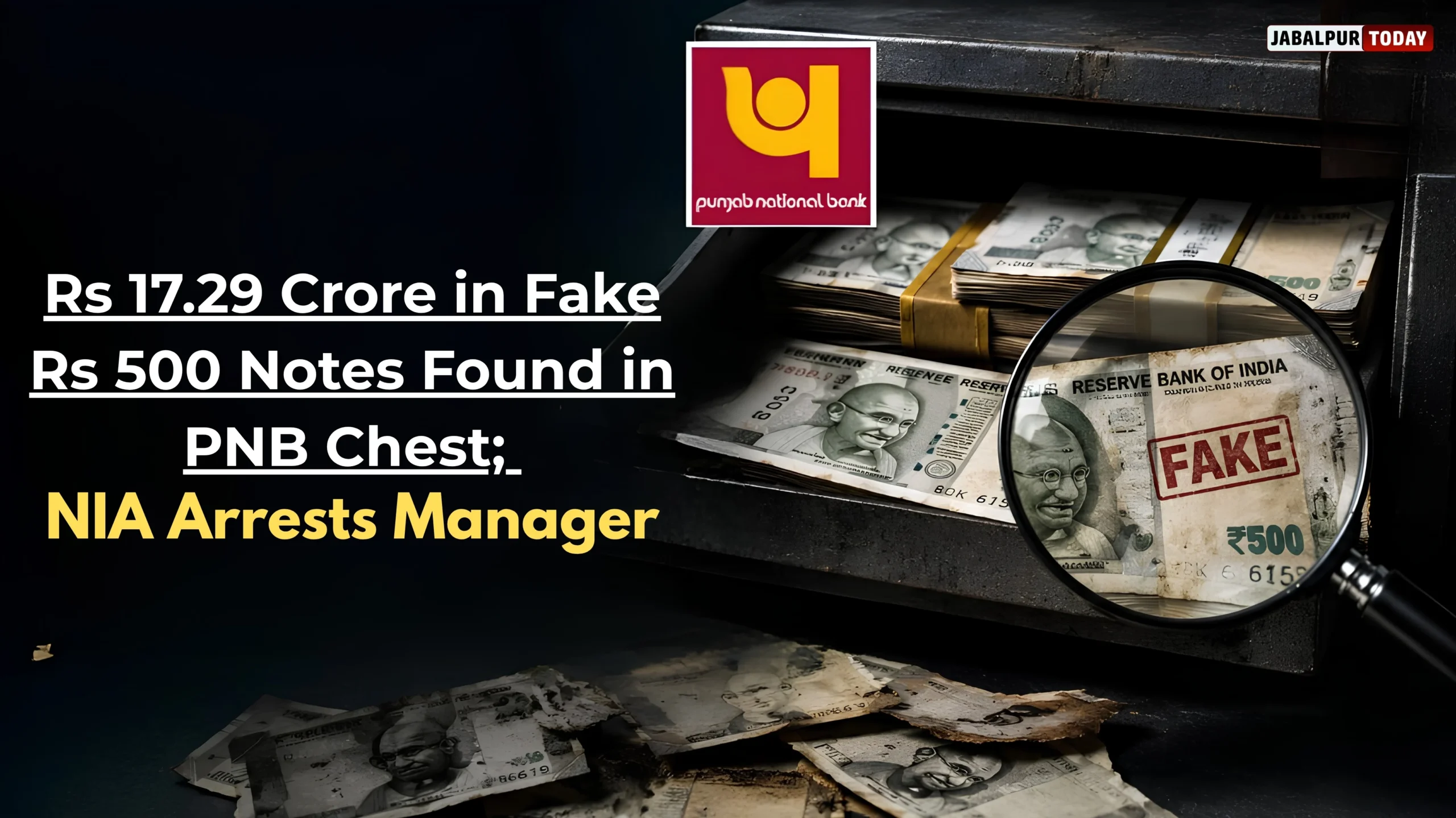
Key accused Amit Kumar arrested in Chandigarh; probe focuses on how fake Rs 500 notes replaced genuine currency inside PNB currency chest
Chandigarh, India: The National Investigation Agency (NIA) has arrested Punjab National Bank (PNB) manager Amit Kumar in a case involving counterfeit Indian currency worth Rs 17.29 crore found inside a bank currency chest in Saharanpur, Uttar Pradesh.
Investigators are now examining how such a large volume of fake Rs 500 notes entered a high-security facility and whether someone replaced genuine currency with counterfeit notes.
Kumar, whom investigators have named as a key accused in the case, previously served as a joint custodian of the Saharanpur currency chest. An NIA team from Lucknow arrested him at his brother-in-law’s residence in Chandigarh on September 7.
A Special NIA Court in Chandigarh granted the agency two days of transit remand to take Kumar to Lucknow, where authorities are expected to produce him before the Special NIA Court.
The case began with the Uttar Pradesh Police and later moved to the NIA after the Ministry of Home Affairs directed the agency to take over the investigation.
How the Fake Currency Was Discovered
The case came to light after officials found a shortage in a cash consignment that a PNB branch linked to the Ghantaghar/Sofia Market currency chest sent to the Reserve Bank of India (RBI) office in Jaipur.
Reports put the shortage at around Rs 4.36 lakh, although some accounts cite a figure of about Rs 4 lakh. Officials detected the discrepancy in cash sent in early August 2026, with reports citing August 5 and August 10-11.
The consignment contained soiled, mutilated and other categories of currency notes.
The shortage prompted an internal inquiry and a detailed audit of the currency chest around August 9.
During the audit, officials found 148 bundles containing counterfeit Rs 500 notes. Each bundle contained 1,000 notes, putting the initial value of the suspected fake currency at Rs 7.40 crore.
Further counting and verification increased the estimated value of the counterfeit notes to around Rs 17.29 crore.
Investigators also found that some bundles appeared to contain genuine notes on top while counterfeit notes allegedly filled the inside. Such a method could allow fake currency to escape detection during a quick inspection.
CCTV Footage Puts Housekeeper Under Probe
Investigators reportedly found CCTV footage showing part-time housekeeper Vishal Kumar removing notes from currency bundles while working inside the currency chest.
Vishal had duties that included arranging and handling currency bundles, including consignments prepared for dispatch to the RBI.
The bank subsequently removed him from his duties, and investigators included him in the case.
PNB Meerut chief manager and nodal officer Arun Kumar Chaubey filed a complaint that led Sadar Bazar police station in Saharanpur to register FIR No. 0431/2026 on August 29.
Police invoked Section 178 of the Bharatiya Nyaya Sanhita (BNS), 2023, which deals with counterfeiting currency. Some reports have also cited provisions related to criminal breach of trust and cheating.
PNB has said the suspected counterfeit currency did not enter circulation through its branches or ATMs.
Three PNB Officials Named in FIR
Three PNB employees faced suspension after the bank’s preliminary inquiry raised questions about their involvement.
Amit Kumar: Kumar worked as a PNB manager and served as a joint custodian of the Saharanpur currency chest when the alleged irregularities occurred. The bank later posted him as manager of the currency chest at Khera Bazaar/Yamunanagar-Jagadhri in Haryana.
After authorities registered the case, Kumar reportedly went missing. The NIA later arrested him in Chandigarh. Investigators have described him as a key accused named in the FIR.
Call records reportedly showed repeated contact between Kumar and his brother-in-law.
Ravi Kumar Kanse: Kanse, also referred to in some reports as Kase or Kansay, worked as a senior divisional manager at the PNB divisional office.
Sushil Sharma: Sharma, also referred to as Sushil Kumar, managed the Saharanpur, or Sofia Market, currency chest.
Investigators are also examining the role of housekeeper Vishal Kumar based on CCTV footage showing him handling currency bundles.
Police teams have searched several residences and seized electronic devices and documents. Authorities also issued lookout notices after concerns that some accused people could attempt to leave the country, including through Nepal.
Investigators carried out searches in Haryana, Uttarakhand and neighbouring districts. Reports say two of the officials live in Yamunanagar, Haryana.
NIA Takes Over Investigation
The Ministry of Home Affairs transferred the case to the NIA because of the seriousness and nature of the alleged offence.
The agency re-registered the case as RC-02/2026/NIA/LKW on September 3.
The NIA is now investigating the wider conspiracy, including the source of the counterfeit currency, how the notes entered the banking system and whether other people helped the accused.
The agency is also working to identify and arrest any other suspects linked to the case.
How Did Fake Notes Enter a High-Security Currency Chest?
The key issue for investigators remains the point at which the counterfeit currency entered the cash chain.
Currency chests store large volumes of notes for distribution to bank branches. Banks operate these facilities under strict security and control procedures, including dual custody, counting, sorting, verification and sealing.
Investigators are examining whether:
- Someone deliberately replaced genuine currency with counterfeit notes inside the chest.
- The fake notes bypassed multiple stages of counting, sorting and verification.
- The counterfeit currency entered while officials received cash from another source.
- Someone introduced the fake notes during internal handling or while officials prepared consignments for the RBI.
- Bank employees worked with people outside the bank.
A 21-member joint team of RBI and PNB officials is tracing the complete cash trail.
The team is examining when the bank received cash, how much it received, where the money came from, how officials moved it inside the system, how they packed it and when they sent it to the RBI.
Officials are also reviewing verification procedures and records of major cash movements.
One report has cited a cash movement of around Rs 111 crore from Saharanpur to RBI Jaipur on July 6 through the currency-handling network.
Investigators are examining such transactions to determine whether the counterfeit notes entered the system during an earlier stage of the cash movement.
NIA Probes Source and Possible Wider Network
Some early reports suggested that the counterfeit notes could have come from sophisticated printing operations designed to imitate genuine Indian currency. Authorities, however, have not publicly confirmed the source.
The NIA is investigating the procurement, movement and source of the fake notes, as well as the accused persons’ contacts, phone records and movements.
Investigators are also examining whether the operation involved a wider organised network that targeted or used India’s formal banking system.
The agency is checking electronic devices and documents seized during searches and is trying to establish whether any counterfeit notes entered circulation before officials detected them.
Is There a Nepal Connection?
Investigators have also examined contacts and movements near the Nepal border.
Authorities issued lookout notices partly because of concerns that suspects could leave India.
Local reports have referred to older counterfeit currency networks linked to Nepal and previous fake currency cases involving other banks in the region.
A separate case in July 2026 involved the arrest of two students, including one from Siddharthnagar, after authorities allegedly found Indian counterfeit notes in Nepal’s Rupandehi district.
However, investigators have not established a direct Nepal connection in the Saharanpur case.
Authorities have also not confirmed any link between this case and a terrorist or organised crime network.
For now, those possibilities remain part of the investigation and not established facts.
Timeline of the Saharanpur Fake Currency Case
- Early August 2026: Officials detect a shortage in a cash consignment sent to RBI Jaipur.
- Around August 9: PNB begins a detailed audit of the currency chest.
- During the audit: Officials find 148 bundles containing fake Rs 500 notes, initially valued at Rs 7.40 crore.
- Further verification: The estimated value of the suspected counterfeit currency rises to around Rs 17.29 crore.
- CCTV review: Investigators examine footage showing housekeeper Vishal Kumar handling currency bundles.
- August 29: Sadar Bazar police station in Saharanpur registers the FIR.
- After the FIR: PNB suspends three officials and removes the housekeeper from his duties.
- Early September: UP Police forms an SIT and conducts searches in Haryana, Uttarakhand and nearby areas. RBI and PNB officials begin tracing the cash trail.
- September 3: NIA takes over the case and registers it as RC-02/2026/NIA/LKW.
- September 7: NIA arrests Amit Kumar in Chandigarh.
- September 8: A Chandigarh court grants two days of transit remand for Kumar’s production before the Special NIA Court in Lucknow.
What Happens Next?
The NIA is expected to question Kumar about the alleged method used to replace genuine currency, the source of the counterfeit notes and the roles of other accused people.
Investigators will also examine whether anyone outside the bank helped move or introduce the fake currency.
The agency will continue investigating the two other suspended PNB officials, housekeeper Vishal Kumar and any other people who may emerge during the probe.
Forensic examination of the counterfeit notes, CCTV footage, bank records, call data and seized electronic devices could help investigators establish the sequence of events.
Why the Case Matters
The discovery is significant because officials found the counterfeit currency inside a bank currency chest, rather than during a street-level seizure, a courier operation or a border interception.
The case raises questions about the security of currency chests and the effectiveness of the systems banks use to count, verify and safeguard large amounts of cash.
It also puts the banking sector’s dual-custody and audit procedures under scrutiny.
For customers and the wider financial system, the case highlights the importance of strong verification controls at every stage of cash handling.
Kumar’s arrest gives investigators a key lead, but the central questions remain unanswered: How did fake currency worth Rs 17.29 crore enter the Saharanpur currency chest, and did anyone remove genuine currency in the process?
The NIA’s investigation will now focus on reconstructing that cash trail and determining whether the case involved an internal substitution, outside assistance or a larger counterfeit currency network.
