
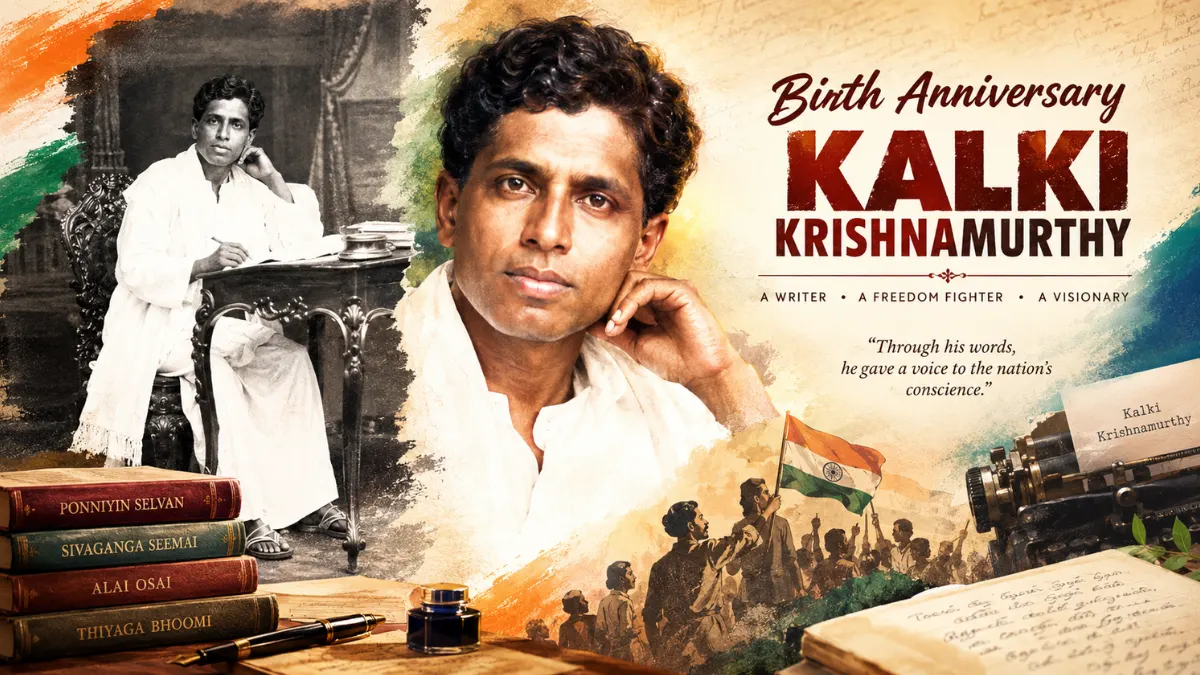
Kalki Krishnamurthy, the 20th-century Tamil writer, journalist and reformer, shaped modern literature through powerful novels, journalism and social writing
New Delhi: Why does a writer who died more than seven decades ago still command such a loyal readership? For Kalki Krishnamurthy, the answer lies in his ability to make literature feel alive. His stories brought history closer to ordinary readers, while his journalism connected writing with India’s freedom struggle and social reform.
Born as Ramasamy Krishnamurthy in 1899, Kalki became one of the most influential Tamil writers and journalists of the 20th century. He wrote historical novels, social fiction, essays, travel pieces, film reviews and political commentary. His best-known works, including Ponniyin Selvan and Sivagamiyin Sabatham, remain widely read. He also helped shape Tamil journalism through Ananda Vikatan and the weekly magazine Kalki. His career showed how journalism and literature could work together to inform, entertain and influence society.
Early Life and Entry into Journalism
Ramasamy Krishnamurthy was born on September 9, 1899, in Puthamangalam near Mayiladuthurai, in the erstwhile Madras Presidency. His early years unfolded during a period when nationalist ideas were spreading rapidly across India.
In 1921, he left school after responding to Mahatma Gandhi’s call for the Non-Cooperation Movement. He joined the freedom struggle and later worked with the Congress. His early political involvement shaped the direction of his writing career.
In 1923, Krishnamurthy joined Navasakti, the nationalist Tamil publication associated with journalist and freedom fighter Thiru Vi. Kalyanasundaram, popularly known as Thiru Vi. Ka. There, he developed his skills as a journalist and writer. He also worked with C. Rajagopalachari at the Gandhi Ashram in Tiruchengode and helped with Vimochanam, a journal that promoted prohibition. His political activism also brought imprisonment, strengthening his belief that journalism could serve a larger public purpose.
A Career Across Publications
Kalki’s journalism career developed through several important Tamil publications. After his work with Navasakti and Vimochanam, he joined Ananda Vikatan in 1932, where editor-publisher S. S. Vasan gave him an important platform. Kalki quickly became known for his sharp political commentary, humour and writing on literature and the arts.
His work at Ananda Vikatan helped him reach a much wider audience. The magazine also serialised several of his stories and novels, allowing readers to follow his characters week after week.
In 1941, Kalki left Ananda Vikatan and returned to the freedom movement. After his release from prison, he joined hands with T. Sadasivam to establish the weekly Kalki in 1941. The publication became an important platform for literature, politics, music and cultural criticism. Kalki remained its editor until his death in 1954.
Kalki’s Remarkable Range as a Writer
Kalki never restricted himself to one form of writing. He moved comfortably between fiction, journalism, criticism, translation and commentary. His body of work included short stories, novels, novellas, essays, travel writing, biographies, political pieces and reviews of music and cinema.
His historical fiction remains particularly famous. Parthiban Kanavu, Sivagamiyin Sabatham and Ponniyin Selvan brought earlier periods of Tamil history to a mass readership. Instead of presenting history as a collection of dry facts, Kalki filled it with characters, conflicts, romance and political intrigue.
His social novels also addressed contemporary concerns. Thyaga Bhoomi dealt with issues such as social inequality and women’s position in society, while Alai Osai explored the impact of India’s freedom struggle on ordinary people.
Kalki’s Alai Osai received the Sahitya Akademi Award for Tamil in 1956, two years after his death, making him a posthumous recipient.
The Birth of “Kalki-Tamizh”
Kalki developed a writing style that readers could recognise almost immediately. His prose combined clarity, humour, rhythm and vivid description. Over time, this accessible style became closely associated with his name and is often described as “Kalki-Tamizh.”
He could describe a historical palace, a village street, a battlefield or a character’s emotion without making the reader feel lost. His descriptions often appealed to the senses, allowing readers to imagine the sights, sounds and atmosphere of a scene.
This quality helped him reach readers beyond traditional literary circles. He could discuss serious political or social questions while maintaining an engaging conversational tone.
His serialised novels also benefited from this approach. Each instalment created curiosity and encouraged readers to return for the next episode. Through this combination of storytelling and accessible language, Kalki helped make Tamil literary writing more popular with a broad audience.
Influence extended with Arts and Social Causes
Kalki’s influence extended well beyond novels and political journalism. He wrote extensively about music, dance, cinema and other forms of culture. Through his criticism, he encouraged audiences to take the performing arts seriously while also making cultural discussions accessible to ordinary readers.
His association with the magazine Kalki strengthened this role. The publication gave space to discussions about music and other artistic traditions alongside literature and public affairs. The magazine also became known for publishing major historical fiction, including Ponniyin Selvan and Sivagamiyin Sabatham.
Kalki also used his writing to support social reform. His nationalist background influenced his views on issues such as caste discrimination, prohibition and women’s rights. His journalism often connected cultural questions with wider concerns about society.
For Kalki, writing was not simply entertainment. He saw the press as a way to influence public thinking, encourage reform and strengthen cultural confidence.
Legacy That Outlives Him
Kalki Krishnamurthy died on December 5, 1954, at the age of 55. Yet his influence did not end with his death. His novels continued to attract new readers, while his journalism helped establish a model for popular Tamil writing that balanced information, entertainment and social awareness.
The continuing popularity of Ponniyin Selvan remains one of the clearest signs of his lasting influence. Its characters and historical world have moved beyond the printed page and entered popular culture through adaptations and new translations.
His recognition also continued after his death. Alai Osai received the Sahitya Akademi Award in 1956, the second year of the award’s Tamil category.
More than a writer, Kalki became a bridge between journalism, literature, history and social reform. He proved that serious ideas could reach mass audiences without losing warmth or imagination. That is why his work continues to matter: Kalki did not simply write for his time. He created stories and ideas that allowed later generations to keep talking with the past.
