
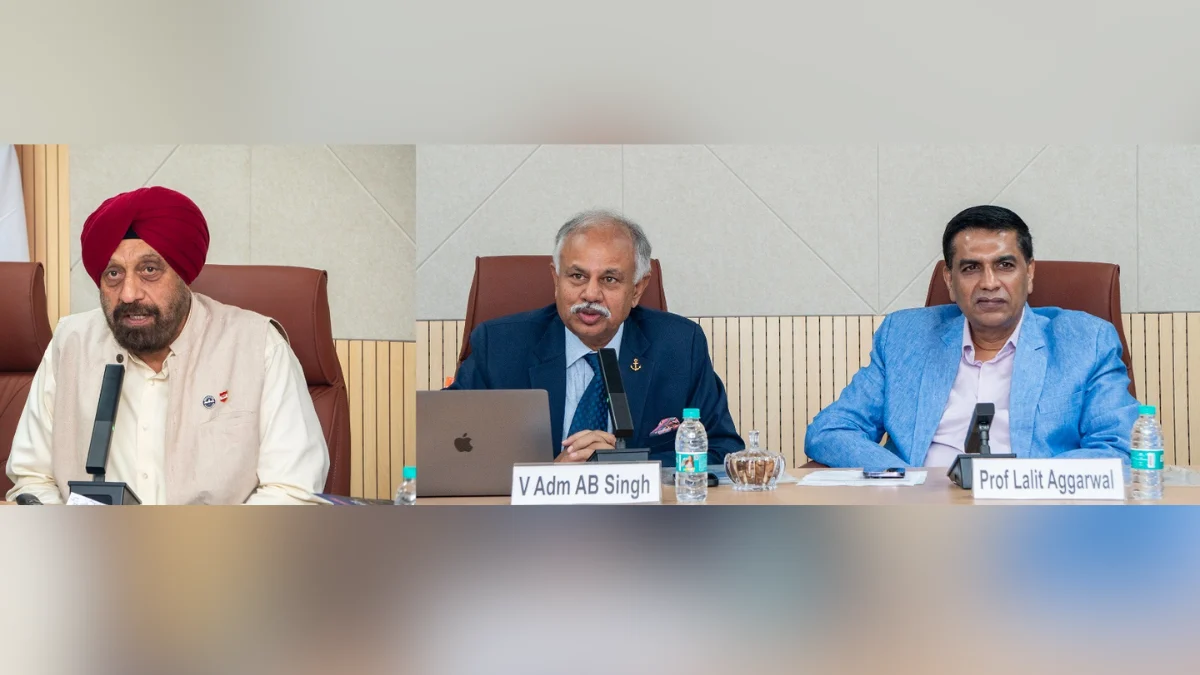
MERI Group and SIA India bring defence experts, scientists and policymakers together to discuss India’s space-maritime strategy, AI, ISR, NavIC and the $30 trillion economy goal for 2047
New Delhi: MERI Group of Institutions, in collaboration with the Space Industry Association of India (SIA India), organised a conference in New Delhi focused on strengthening the integration of India’s space and maritime capabilities. The discussions centred on national security, economic growth and India’s vision of becoming a Viksit Bharat with a $30 trillion economy by 2047.
The conference brought together defence experts, scientists, academics and policy leaders to explore how closer coordination between the space and maritime sectors can create new opportunities for India.
Focus on an Integrated Space-Maritime Strategy
Lalit Aggarwal, Vice-President of MERI Group, said the traditional distinction between the space and maritime domains is changing rapidly. He highlighted the need for universities and academic institutions to encourage interdisciplinary research and prepare professionals with expertise in space technology, maritime affairs, data science and national security.
Space-Based Surveillance to Strengthen Maritime Security
Vice Admiral Ajendra Bahadur Singh (Retd.) underlined the importance of space-based surveillance in the Indian Ocean Region. He said traditional surveillance systems alone cannot provide complete visibility across the maritime domain.
He emphasised the role of Intelligence, Surveillance and Reconnaissance (ISR) systems and integrated sensor networks in monitoring maritime activity, protecting sea lanes and responding to emerging grey-zone challenges.
AI and Satellite Data for Strategic Intelligence
Lt. Gen. P.J.S. Pannu (Retd.), Dean of the Department of Space Studies, stressed the importance of technological self-reliance and a strong indigenous data ecosystem.
He called for closer integration of Geographic Information Systems (GIS), Positioning, Navigation and Timing (PNT), ISR and Artificial Intelligence (AI) to convert satellite data into actionable intelligence for strategic and operational decision-making.
Space Technology to Support the Blue Economy
The conference also examined the role of space and maritime technologies in shipping, fisheries and logistics. Experts noted that accurate hydrographic surveys and digital maritime mapping can improve navigation, cargo movement and logistics efficiency.
Satellite-based data can also help fishing communities identify potentially productive fishing zones, creating opportunities for more efficient and technology-driven fisheries management.
Better Disaster Preparedness Through Space Technology
Participants highlighted the growing importance of satellite observations, weather monitoring, ocean forecasting and cyclone tracking in strengthening coastal disaster management.
These technologies can improve early-warning systems and help authorities prepare for cyclones and other maritime hazards, particularly in vulnerable coastal regions.
Push for NavIC and Small-SAR Satellite Constellations
The experts called for greater investment in small-SAR satellite constellations, stronger indigenous PNT capabilities and wider adoption of India’s NavIC navigation system.
They also stressed the importance of collaboration among the government, Indian Navy, shipping companies, technology firms, universities and research institutions.
The conference concluded that closer integration of India’s space and maritime capabilities can strengthen national security while supporting maritime trade, fisheries, the blue economy, disaster resilience, innovation and technological self-reliance.
Experts said a coordinated space-maritime ecosystem could become an important contributor to India’s Viksit Bharat 2047 vision and $30 trillion economy goal.
