
A Year After Puri Promised “Never Again,” Two More Devotees Are Dead. What Went Wrong This Time?
New Delhi: A year ago, Odisha Chief Minister Mohan Charan Majhi stood before the media after a deadly stampede during the Puri Rath Yatra. He called the incident an act of “unforgivable negligence.” He removed the district collector, suspended the superintendent of police, ordered a month-long inquiry, and promised that such a tragedy would never happen again.
This year, the government made major security arrangements. Officials deployed thousands of extra police personnel, installed AI-powered CCTV cameras, and involved the Navy and Coast Guard to improve safety.
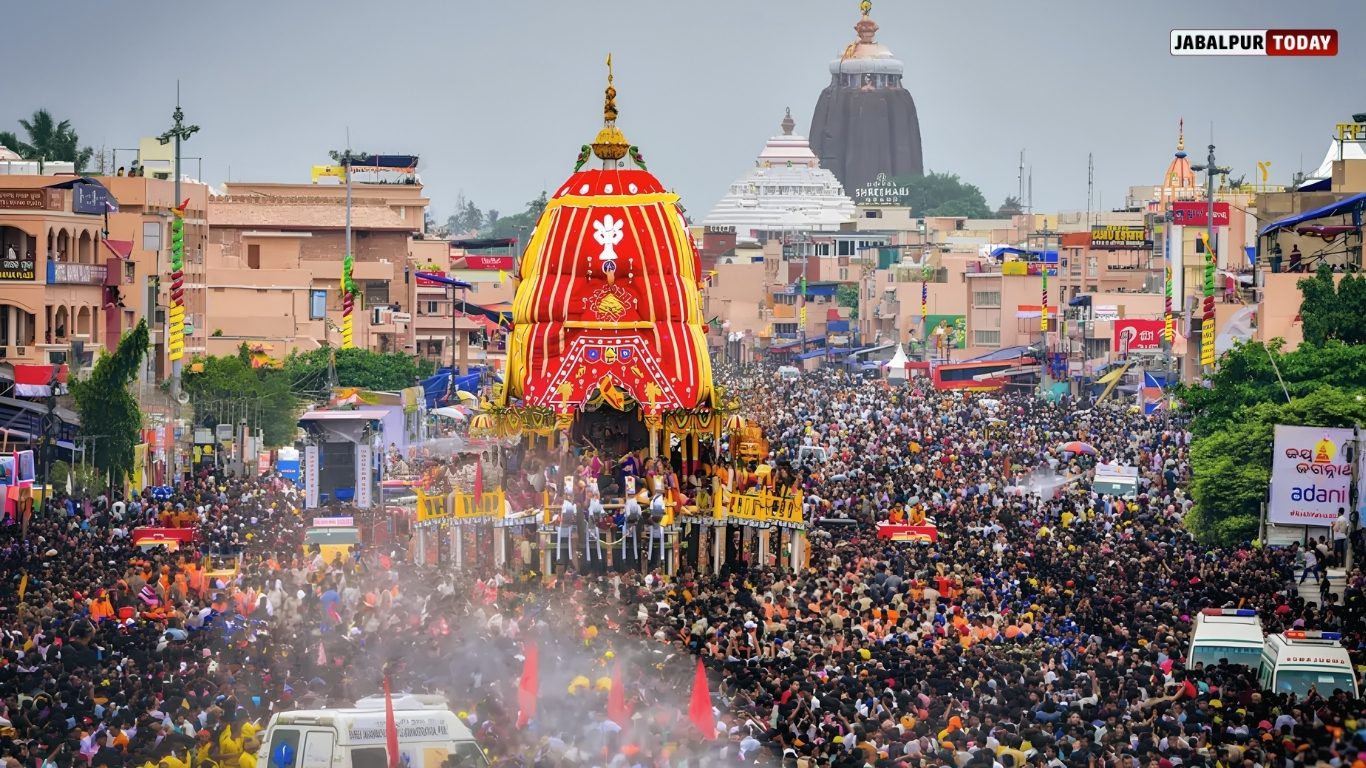
Yet, on Thursday, lakhs of devotees gathered once again on Puri’s Grand Road to watch Lord Jagannath’s chariot move towards the Gundicha Temple. During the celebrations, a stampede-like situation broke out. Two people lost their lives and nearly 100 others were injured. The incident happened almost exactly one year after the previous tragedy and only a few kilometres away from the earlier spot.
This is not just the story of another tragic day in Puri. It is also about what happens when authorities investigate a disaster, promise reforms, and still fail to stop a similar incident from happening again.
What Happened on Thursday
The chaos started on Bada Danda, also known as Puri’s Grand Road, as devotees rushed forward to witness the sacred Pahandi ritual. During this ceremony, servitors carry the idols of Lord Jagannath, Lord Balabhadra, and Devi Subhadra from the Jagannath Temple to their chariots.
According to reports, the crowd became extremely dense near the Singhadwara (Lion’s Gate) and Marichikote Chhak, around 500 metres beyond the outer security barrier. As the pressure inside the crowd increased, people struggled to move.
One devotee, identified as Anil Das, reportedly lost his balance and fell. People around him continued moving, and he got trapped in the crowd. Rescue teams rushed him to Puri District Headquarters Hospital, where doctors declared him dead. Another devotee later died due to suffocation caused by the heavy crowd.
Different reports have given different estimates of the number of injured people. Some reports say around 100 people suffered injuries, while others place the number above 200. Most reports agree that nearly 50 people required hospital treatment. Many complained of breathing problems, while medical teams treated others with first aid at the spot. Emergency workers carried injured devotees away on stretchers as the rituals continued, and many people in the larger crowd did not even realise that an emergency was unfolding nearby.
Officials have not yet confirmed what exactly triggered the crush.
The tragedy happened despite one of the biggest security deployments in recent years. Authorities had deployed around 12,000 to 13,000 police personnel, including 19 IPS officers and more than 200 executive magistrates. The Navy and Coast Guard carried out joint coastal patrols. More than 500 lifeguards and fire service personnel remained on duty, while AI-based surveillance systems monitored the festival. The government had strengthened all these arrangements after last year’s tragedy.
Earlier that morning, Chief Minister Mohan Charan Majhi had personally reviewed the preparations and instructed officials to ensure the safety of devotees. Former Chief Minister Naveen Patnaik also expressed condolences after the incident and urged the government to improve crowd management.
Déjà Vu on the Grand Road
This marks the second consecutive year in which devotees have died during the Rath Yatra due to a crowd crush.
On June 29, 2025, a stampede near the Gundicha Temple at Saradhabali claimed the lives of three devotees — Prabhati Das, Basanti Sahu, and 70-year-old Premakant Mohanty. More than 50 others suffered injuries after an early morning crowd rushed forward to see the deities on the parked chariots.
After that tragedy, Chief Minister Majhi publicly apologised and called the incident a result of “unforgivable negligence.” The government announced ₹25 lakh compensation for each victim’s family. It also transferred Puri’s district collector and superintendent of police and suspended two police officers.
The state appointed Development Commissioner Anu Garg to investigate the incident. Her committee spent more than a month examining the case. The panel recorded statements from around 70 people, including eyewitnesses, government officials, temple servitors, and family members of the victims. It submitted its report to the Chief Minister in late July 2025.
Reports later revealed several serious findings.
The committee found that unusually pleasant weather had attracted a much larger crowd than expected. Authorities allowed two trucks carrying sacred “charamala” wood to enter the already crowded Saradhabali area to remove materials from the chariots. Officials also reopened darshan in the early morning without proper planning.
The inquiry also found major technical failures. Out of 275 CCTV cameras approved under Puri’s Integrated Command and Control Centre, only about 123 worked on the day of the stampede. As a result, officials could not monitor large parts of the crowd.
The report also stated that senior officers were missing from several key locations. It further found that the control room did not realise a stampede had occurred until after the incident.
In November 2025, the Odisha government recommended disciplinary action against seven police officers, including a Deputy Superintendent of Police. Officials also proposed action against a forest department officer whose lapses were linked to the incident.
Families of the victims later alleged that authorities had focused more on managing VIP movement than controlling the crowd.
Reforms on Paper, Repetition on the Ground
Before this year’s Rath Yatra, the Odisha government significantly strengthened security arrangements.
Authorities almost doubled the number of police personnel compared to parts of last year’s deployment. They appointed more executive magistrates, added a stronger maritime security layer, and fully activated the AI-based surveillance system that had failed during the 2025 tragedy. Officials repeatedly said they had “left no stone unturned” to ensure devotees’ safety.
Despite these efforts, Thursday’s tragedy still happened.
That is the biggest concern. The issue is not only that another crowd crush occurred. The more important question is why it happened even after the government had already identified its own mistakes in last year’s inquiry.
The 2025 report did not blame an unavoidable accident. Instead, it pointed to clear problems that authorities could fix. These included non-working CCTV cameras, vehicles entering crowded areas, the absence of senior officers at critical points, and a control room that failed to detect the emergency in time.
The purpose of such an inquiry is to ensure that these mistakes do not happen again.
Yet, a similar weakness appears to have returned. Once again, a huge crowd gathered in a limited space, officials struggled to monitor pressure building inside the crowd in real time, and lives were lost.
Another important point remains unresolved.
Nearly one year after Anu Garg submitted her report, the Odisha government has still not made the complete inquiry report public. Officials have only shared selected findings, including the officers who faced disciplinary action and some broad reasons behind the tragedy.
Families of the victims and several civil society groups have repeatedly asked the government to release the full report.
Without complete public disclosure, it becomes difficult for citizens—and even for administrators—to check whether officials truly implemented the recommendations or simply increased manpower and installed more cameras without solving the deeper problems.
The Bigger Question: Can Faith and Crowd Control Coexist at This Scale?
Managing the Rath Yatra crowd has never been easy.
Every year, lakhs of devotees gather on one centuries-old road to witness a deeply sacred event. Everyone wants to reach the same place at nearly the same time. Religious rituals decide the schedule, leaving little flexibility for crowd movement.
Experts have often compared Puri with other major religious gatherings in India, including the Kumbh Mela and several temple festivals where crowd crushes have also occurred. These events share common challenges: massive crowds, limited space, and administrative systems that sometimes fail under extreme pressure.
However, Puri’s case stands out for one important reason.
This is no longer the first time the state has faced such a tragedy. Within two years, the same festival has witnessed two fatal crowd crushes. Authorities conducted a detailed investigation after the first incident, announced several reforms, and promised better safety. Even so, another tragedy has occurred, and officials have once again said they are investigating the exact cause.
That repeated pattern should worry policymakers more than the individual incidents themselves.
A single tragedy may result from unexpected circumstances. But when another similar incident happens just one year later—with sudden crowd pressure, breathing difficulties, deaths near a congested point on the same route, and despite major reforms—it raises a much bigger question.
Has Odisha truly redesigned its crowd management system based on the failures identified in 2025? Or has it simply added more police personnel, more CCTV cameras, and more magistrates without addressing the basic challenge of managing an ever-growing crowd on a road and within a ritual schedule that cannot expand?
What Comes Next
As of Thursday evening, officials said they were still investigating the exact cause of the crowd crush and would submit a detailed report.
Most injured devotees are reportedly recovering. Chariot pulling continued despite the tragedy, just as it did last year. The nine-day Rath Yatra festival is also expected to continue with the remaining rituals at the Gundicha Temple.
For the families of the two devotees who died this Thursday, and for those who lost loved ones in 2025, the biggest question is unlikely to be about AI surveillance systems or police deployment.
They will want to know why, after everything the government said it had learned from last year’s tragedy, the road to Lord Jagannath’s chariot claimed lives once again.

Mansi Sharma is a journalist covering Global Affairs, and wellness, known for turning complex ideas into sharp, engaging narratives. Her work is driven by curiosity, depth, and a constant urge to question and explore. When she’s not writing, you’ll often find her diving into new ideas—preferably with a cup of coffee in hand, one sip at a time.