
Indonesia honoured PM Modi with its highest award, while key talks on missiles, Sabang Port and rare earth minerals shaped the visit’s strategic significance
Jakarta: Indonesia awarded Prime Minister Narendra Modi its highest civilian and military honour, the Bintang Adipurna (Star of the Republic of Indonesia), on Tuesday during his visit to Jakarta. However, the visit extended far beyond the ceremonial recognition, as both countries advanced discussions on defence cooperation, the joint development of the strategically located Sabang Port near the Strait of Malacca, investments in critical minerals, and other initiatives that could significantly strengthen India’s strategic presence in the Indo-Pacific.
The visit also included major discussions on defence, ports, and critical minerals. News agencies mentioned these developments only briefly, but they reveal much more about the real purpose of Modi’s visit to Indonesia than the award ceremony itself.
The Ceremony
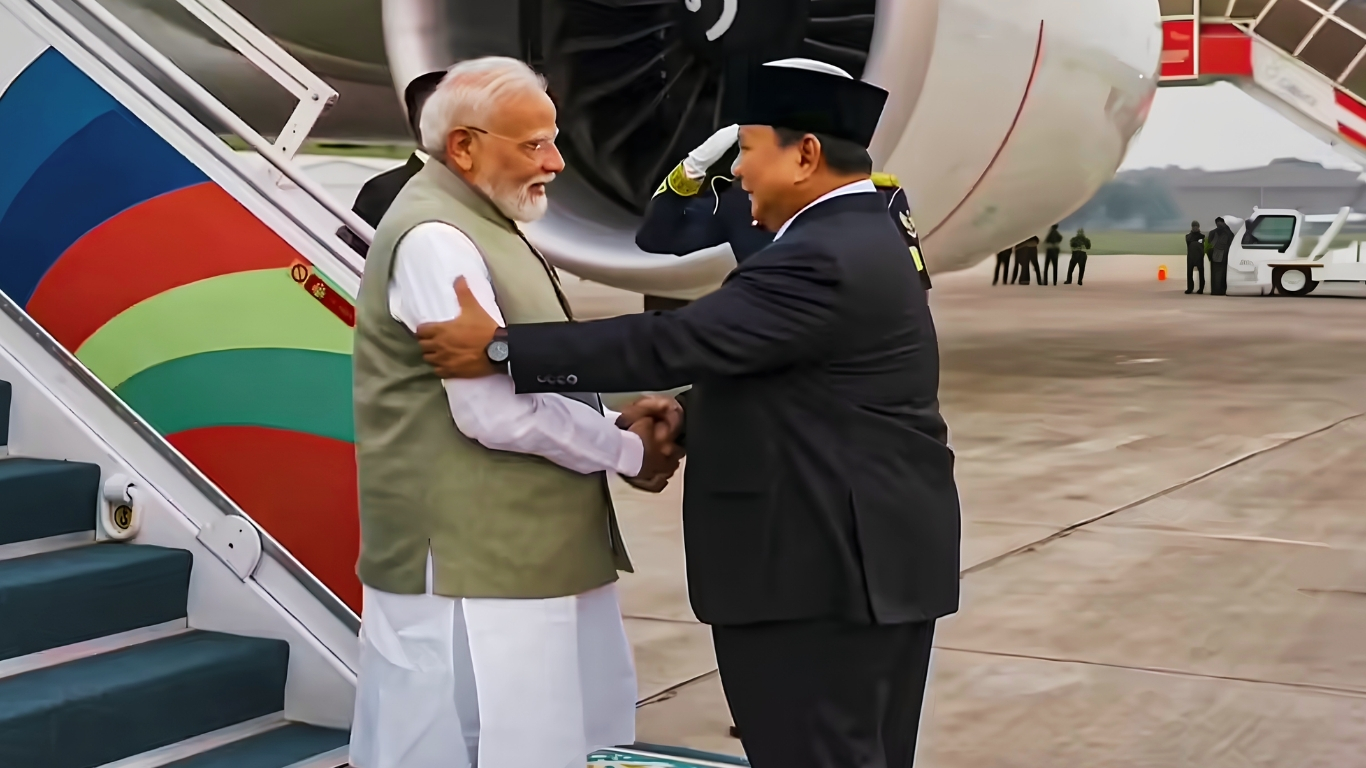
Prime Minister Modi arrived in Jakarta on Monday afternoon as part of a three-nation tour that will also take him to Australia and New Zealand. President Prabowo Subianto personally welcomed him at the airport, a gesture that diplomats rarely make. Modi later posted on X that the warm reception had touched him.
On Tuesday, schoolchildren lined the roads as Modi travelled to the Merdeka Palace. They waved the flags of both India and Indonesia. President Subianto welcomed Modi with a hug on the palace steps. Both countries played their national anthems before officials conducted a grand ceremonial welcome.
Modi signed the official guestbook, and the two leaders posed for photographs before President Subianto announced the Bintang Adipurna award.
India’s Ministry of External Affairs described the visit as another important step in strengthening the India–Indonesia Comprehensive Strategic Partnership, which both countries established in 2018. Although Modi has visited Indonesia four times, this marked his first bilateral visit since both countries upgraded their relationship to that strategic partnership. In effect, this visit fulfilled plans that had remained on paper for seven years.
Many reports described the Bintang Adipurna as Indonesia’s highest civilian honour, but that description is incomplete. The award actually serves as both a civilian and military honour. Indonesia presents it to both its own citizens and foreign leaders who have significantly contributed to the country’s interests. Therefore, Indonesia did not grant the honour as a routine diplomatic courtesy. Instead, it deliberately used the award to send an important diplomatic message.
Modi’s Growing List of International Honours
The Indonesian award adds to a long list of international honours that Modi has received in recent years.
During the last two years alone, Brazil awarded him the Grand Collar of the National Order of the Southern Cross. Trinidad and Tobago, Ghana, Cyprus, Namibia, Mauritius, Nigeria, Dominica, Bhutan (for a second time), and Seychelles also honoured him with their highest civilian awards. Seychelles presented him with the “Guardian of the Blue Horizon” award for environmental leadership only last month.
Earlier, Russia honoured him with the Order of St Andrew the Apostle. France awarded him the Grand Cross of the Legion of Honour. Egypt honoured him with the Order of the Nile, while the United Arab Emirates presented him with the Order of Zayed. Saudi Arabia also awarded him the Order of Abdulaziz Al Saud.
Viewed separately, each honour represents a diplomatic gesture of goodwill. Viewed together, they reveal a consistent pattern. Indian officials and many commentators openly point out that almost every award has coincided with bilateral visits that produced concrete agreements involving trade, defence, connectivity, energy, ports, minerals, or cooperation with the Indian diaspora.
In other words, these awards often accompany important strategic agreements rather than stand alone. The Indonesian honour follows exactly the same pattern because the visit focused heavily on defence cooperation, mineral partnerships, and maritime infrastructure.
The Main Business: Defence, Minerals and Technology
Several important agreements moved forward alongside the ceremonial events, and these developments could have a much greater impact on regional security than the medal itself.
Defence Cooperation
According to Indian government sources quoted by news agencies, Indonesia has decided to import India’s Astra air-to-air missiles after observing their reported performance during Operation Sindoor.
Indonesia also plans to expand its existing inventory of BrahMos supersonic cruise missiles. India is expected to support this expansion by supplying additional missile batteries.
Indonesia became the first country outside India’s immediate neighbourhood to purchase BrahMos missiles. This expansion would strengthen one of India’s most significant defence export partnerships.
Critical Minerals
India also plans to invest in Indonesian industries that produce steel, nickel, and rare-earth permanent magnets.
These materials play an essential role in manufacturing electric vehicles, wind turbines, electronics, and defence equipment. China currently dominates much of the global supply chain for these critical minerals.
Indonesia possesses some of the world’s largest nickel reserves. By investing in Indonesia’s mineral sector, India aims not only to secure commercial opportunities but also to strengthen its long-term economic and strategic security.
Electronic Voting Machines
India also plans to help Indonesia develop electronic voting machines designed specifically for Indonesian elections.
This initiative would allow India to export its election-management expertise and expand its soft power, although many news reports mentioned this development only briefly.
Sabang and Great Nicobar: The Most Important Part of the Visit
The most significant outcome of the visit concerns maritime cooperation and centres on a port that many Indians have never heard of.
India and Indonesia plan to jointly develop Sabang Port, a deep-water port located on Weh Island at the northern tip of Sumatra near the entrance to the Strait of Malacca.
Sabang lies approximately 90 to 104 nautical miles from Indira Point, India’s southernmost point in the Andaman and Nicobar Islands. The port also lies only about 500 kilometres from the Strait of Malacca.
Its location gives Sabang enormous strategic importance.
The port sits almost directly across the sea from India’s Great Nicobar Project, a ₹9-billion development centred around the Galathea Bay International Transshipment Port, along with a new airport, power infrastructure, and an entirely new township on Great Nicobar Island.
India and Indonesia first agreed to cooperate on Sabang in 2018 when Modi and then-Indonesian President Joko Widodo created a joint task force to improve connectivity between Aceh Province and India’s Andaman and Nicobar Islands.
Both countries have now accelerated that plan and are simultaneously expanding infrastructure on both sides of the Strait of Malacca.
Why Sabang Matters?
The importance of Sabang extends far beyond port development.
The Strait of Malacca serves as the world’s busiest shipping route. About 25 percent of global trade passes through this corridor. Around 70 to 80 percent of China’s crude oil imports also travel through the strait.
Chinese leaders themselves have referred to this dependence as the “Malacca Dilemma,” a term introduced by former Chinese President Hu Jintao in 2003.
India already occupies a strategically important position because the Andaman and Nicobar Islands overlook the western entrance to the strait.
If India and Indonesia successfully develop ports at both Great Nicobar and Sabang, India will gain a much stronger ability to monitor shipping traffic passing through this critical maritime chokepoint. During a major crisis, India could potentially use this position to influence or constrain maritime movement through the area.
Strategic analysts describe this cooperation as part of India’s broader “Necklace of Diamonds” strategy in the Indian Ocean, which seeks to balance China’s expanding “String of Pearls” network of ports across the region.
No military band announced these developments, and no ceremonial event highlighted them. Government sources quietly shared the information with news agencies, and many reports gave it little attention. Yet these decisions may prove far more important than the medal ceremony over the next decade.
Why the Visit Matters Now
This visit also carries significant timing.
Modi had not made a bilateral visit to Indonesia since both countries upgraded their relationship to a Comprehensive Strategic Partnership in 2018. Seven years passed before both governments organised a leader-level visit to fully advance that partnership.
The visit also followed President Prabowo Subianto’s trip to New Delhi as the chief guest for India’s Republic Day celebrations earlier this year. That visit prepared the ground for Modi’s reciprocal visit to Indonesia.
India has also increased its regional engagement through its Act East Policy and its newer MAHASAGAR vision, which stands for Mutual and Holistic Advancement for Security Across the Regions. These initiatives emphasise stronger cooperation in infrastructure, defence, maritime security, and critical minerals—the same priorities that dominated discussions in Jakarta.
Before leaving New Delhi, Modi said that his three-country tour of Indonesia, Australia, and New Zealand would strengthen India’s vision of a “free and open Indo-Pacific.” When viewed alongside the Sabang and Great Nicobar projects, those words carry clear strategic meaning rather than serving as general diplomatic language.
During the visit, Modi and President Subianto are also expected to visit the Prambanan Temple complex in Yogyakarta together. This cultural programme highlights the centuries-old civilisational links between India and Indonesia and reminds both countries that their relationship extends beyond strategic and economic cooperation.
Indonesia marks the first stop on Modi’s three-nation tour. He will next travel to Australia and then New Zealand.
Neither government has yet officially confirmed the timeline for the Sabang Port project or the reported Astra missile deal through a joint statement. At present, government sources have shared these developments with news agencies, but both countries have not yet signed or formally published all the agreements.
Both governments will likely provide greater clarity after issuing an official joint statement.

Mansi Sharma is a journalist covering Global Affairs, and wellness, known for turning complex ideas into sharp, engaging narratives. Her work is driven by curiosity, depth, and a constant urge to question and explore. When she’s not writing, you’ll often find her diving into new ideas—preferably with a cup of coffee in hand, one sip at a time.