
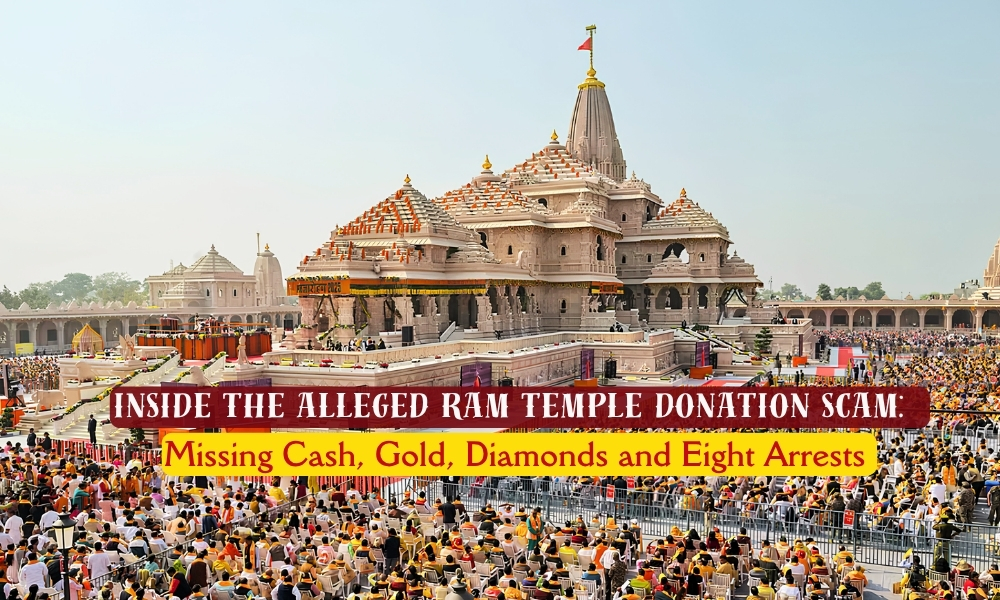
The alleged Ram Temple donation scam explained: missing cash, gold and diamonds, eight arrests, the SIT probe and what investigators have found so far
New Delhi: Eight people have landed behind bars. Investigators are probing allegations that crores of rupees, along with gold, silver and diamond donations made by millions of devotees, went missing from the Ram Temple in Ayodhya. As the Uttar Pradesh government’s Special Investigation Team (SIT) digs deeper, the controversy has grown into one of the biggest financial probes involving a religious institution in India’s history.
From a Symbol of Faith to the Centre of a Criminal Probe
The inauguration of the Ram Temple in Ayodhya on January 22, 2024, marked one of the defining moments in modern India. After decades of legal disputes, political campaigns and religious movements, Prime Minister Narendra Modi consecrated the temple before millions of viewers in India and abroad.
The government created the Shri Ram Janmabhoomi Teerth Kshetra Trust to manage the temple and safeguard the donations made by devotees. Less than two-and-a-half years later, the trust finds itself at the centre of a major criminal investigation.
Uttar Pradesh Police have arrested eight people linked to the trust, while the state’s Special Investigation Team has flagged serious lapses in surveillance, accounting and financial management. Senior figures associated with the Ram Temple project have also publicly criticised the trust’s functioning, with one calling the alleged wrongdoing an “open robbery.”
The investigation has raised difficult questions about how one of India’s most revered religious institutions allegedly failed to protect donations entrusted by millions of devotees.
How the Allegations Began
The controversy erupted on June 7, 2026, when former Samajwadi Party MLA Pawan Pandey alleged that between ₹7 crore and ₹7.5 crore donated by devotees had either been stolen or embezzled.
Within days, opposition leaders claimed the alleged scam was much larger. Aam Aadmi Party national convenor Arvind Kejriwal alleged that nearly ₹200 crore in cash, along with gold jewellery, silver ornaments and diamonds donated by devotees, had gone missing. He also questioned why the Uttar Pradesh Police, the Enforcement Directorate (ED) and the Central Bureau of Investigation (CBI) had not acted earlier, accusing the government of shielding influential people linked to the trust.
These remain allegations, and investigators have not confirmed the ₹200 crore claim.
Financial records show that the trust received ₹82.78 crore in donations between April 2025 and February 2026. Including interest income, its total income reportedly reached ₹220.81 crore during the same period.
The central question soon shifted from how much money the temple received to what happened to the donations.
Why Investigators Focused on the Maha Kumbh Period
Investigators believe the alleged irregularities peaked during January and February 2025, when the Maha Kumbh Mela drew massive crowds to the region.
According to the investigation, nearly 10 lakh devotees visited the Ram Temple every day during this period. Donation boxes filled rapidly with cash, while devotees also offered gold, silver, diamonds and other valuables.
The SIT believes the combination of huge crowds, enormous donations and weak administrative controls created an opportunity for large-scale financial irregularities.
During the investigation, officials reportedly failed to explain how they recorded, stored and managed valuable donations. The SIT found missing records, no comprehensive inventory system, heavy reliance on verbal instructions instead of written orders and almost no standard operating procedures for handling valuable offerings.
Investigators say these shortcomings left the trust with little accountability over donations worth crores of rupees.
CCTV Failures Raise Fresh Questions
One of the most damaging findings concerns the temple’s surveillance system.
Nripendra Misra, chairman of the temple’s construction committee and former Principal Secretary to Prime Minister Narendra Modi, publicly acknowledged serious shortcomings. Speaking to television channels, he said CCTV surveillance across the temple premises was either “non-existent or poor” and described the vigilance mechanism as “zero.”
According to Misra, analysts reviewing available CCTV footage found indications that one individual handled the inflow and outflow of donations and allegedly kept bundles of cash in personal custody instead of following institutional procedures.
Misra blamed the situation on a severe lack of administrative experience.
His remarks contrasted with Uttar Pradesh Chief Minister Yogi Adityanath’s response. Addressing the controversy during a visit to Ayodhya on June 19, Adityanath urged people not to jump to conclusions and asked devotees to wait for the SIT’s findings, while suggesting that some forces wanted to defame Ayodhya.
How the SIT Began Its Investigation
As public pressure mounted, the Uttar Pradesh government formed a three-member Special Investigation Team on June 13, 2026.
The team comprises:
• Vijay Vishwas Pant, Lucknow Divisional Commissioner
• S. Kiran, Inspector General of Police
• Neel Ratan, Special Secretary, Uttar Pradesh Finance Department
Notably, the government formed the SIT after the Shri Ram Janmabhoomi Teerth Kshetra Trust itself requested an investigation.
The SIT quickly directed trust officials not to leave Ayodhya and began examining financial records, donation registers and the handling of valuables.
According to investigators, the trust failed to issue receipts for significant quantities of donated gold, silver and other valuables. Officials also relied heavily on verbal instructions, leaving little documentary evidence for important financial decisions.
Investigators continue to examine whether these lapses resulted from negligence or deliberate misconduct.
Preliminary Report Sparks Fresh Controversy
On June 23, 2026, SIT chairman Vijay Vishwas Pant submitted the preliminary report to Additional Chief Secretary (Home) Sanjay Prasad.
Opposition parties criticised the move because Prasad also serves as the Uttar Pradesh government’s ex-officio representative on the Shri Ram Janmabhoomi Teerth Kshetra Trust. They argued that the arrangement created a potential conflict of interest.
The government rejected those allegations.
Meanwhile, investigators widened the probe to examine land purchases made during the temple project and procurement of construction materials. These inquiries revived earlier allegations by the Samajwadi Party and the Aam Aadmi Party that some land parcels had been purchased at prices significantly above market value. The SIT has not reached any final conclusions on those transactions.
Eight Arrests and the First FIR
The investigation reached a major milestone on June 26, 2026, when Uttar Pradesh Police arrested all eight people named in the first FIR.
Trustee Krishna Mohan, a retired Indian Forest Service officer who joined the trust in September 2025, filed the complaint.
The accused are:
- Avinash Shukla
- Anukalp Mishra
- Lavkush Mishra
- Manish Kumar Yadav
- Karunesh Pandey
- Ramashankar Mishra
- Subhash Srivastava
- Ram Shankar Yadav alias Tinnu
The FIR also names unidentified persons, indicating investigators suspect additional individuals may have played a role.
Police booked the accused under multiple sections of the Bharatiya Nyaya Sanhita and the Prevention of Corruption Act, including charges of theft, criminal breach of trust, receiving stolen property and criminal conspiracy.
Why the Arrests Did Not End the Controversy
The FIR did not name two of the trust’s senior members, Champat Rai and Anil Mishra, triggering fresh political debate.
According to sources familiar with the investigation, two of the arrested men—Lavkush Mishra and Anukalp Mishra—played key roles in counting cash and valuable donations.
Former Uttar Pradesh Chief Minister Akhilesh Yadav alleged that investigators targeted only lower-level functionaries while protecting senior figures. He also claimed authorities used the SIT process to erase evidence before registering the FIR.
The Uttar Pradesh government has rejected those allegations and maintains that the investigation remains impartial.
The Mystery of the 200 Silver Bricks
The controversy extends beyond missing cash.
Dr Raju V. Manwani, Chairman of the Castles Group of Companies, says he donated 200 silver bricks, each weighing one kilogram, to the Ram Temple trust on January 26, 2021, on behalf of the Sindhi community.
According to Manwani, he personally handed the bricks to Champat Rai but never received an official receipt. Trust officials allegedly told him they would first examine the silver before deciding how to use it.
As the donation controversy unfolded, Manwani publicly demanded that the trust issue a receipt and disclose how it used the silver bricks.
The trust had not publicly responded to his demands at the time of writing.
The Vishwa Sindhi Seva Sangam also called on the trust to explain the whereabouts of the donation, adding another layer to the controversy over documentation and transparency.
Political Fallout Intensifies
The scandal has triggered a fierce political battle.
Opposition parties accuse the BJP government of failing to protect donations made by devotees.
Shiv Sena (UBT), in an editorial published in Saamana, compared the alleged looting of Ram Temple donations with the medieval plundering of the Somnath Temple by Mahmud of Ghazni.
The Vishva Hindu Parishad (VHP), despite supporting the Ram Temple project, also demanded strict legal action. It called for an FIR, a speedy investigation, a fast-track trial and swift punishment if anyone is found guilty.
A High-Stakes Issue Before the 2027 Elections
The controversy has acquired political significance because Uttar Pradesh will hold Assembly elections in 2027.
VHP President Alok Kumar accused opposition parties of exploiting the allegations to target both the Ram Temple project and the BJP.
Political observers, however, believe the case could become one of the state’s biggest accountability issues before the elections.
For millions of devotees, the issue extends beyond politics. They donated money, jewellery and valuables believing they were contributing to a sacred cause. Allegations that those offerings may have been stolen or misused have deeply shaken public trust.
The Supreme Court Steps In
The matter has now reached the Supreme Court of India through a Public Interest Litigation (PIL).
The petition seeks directions to preserve financial records, digital evidence and CCTV footage connected with the case. It also requests an independent investigation supervised by retired judges of the Allahabad High Court and a comprehensive audit of the trust’s finances by the Comptroller and Auditor General (CAG).
The proposed audit would examine the trust’s accounts from its inception until the present.
The Supreme Court has not yet decided how it will proceed.
Beyond the arrests and political accusations, the controversy raises fundamental questions about accountability.
The Shri Ram Janmabhoomi Teerth Kshetra Trust managed one of India’s most important religious projects and handled donations worth hundreds of crores. Yet investigators allege it lacked many of the safeguards expected in institutions responsible for such large public contributions.
Critics argue that the trust operated without sufficient independent oversight, transparent accounting systems or robust public audits.
They also question the sequence of events. An opposition leader first raised the allegations. The trust then requested an SIT investigation. Later, the SIT submitted its preliminary report to a senior government official who also serves on the trust’s governing body, prompting allegations of a conflict of interest. The government has rejected those concerns.
The Investigation Is Still Far From Over
Although police have arrested eight people, investigators continue to examine financial records, donation registers, CCTV footage, accounting procedures, land transactions, procurement decisions and the movement of cash and valuables inside the temple.
Several crucial questions remain unanswered.
How much money, if any, actually went missing?
Where are the gold ornaments, silver items, diamonds and other valuables that devotees donated?
Why did the trust allegedly fail to issue receipts for significant donations?
Who approved the administrative systems that investigators now say failed so badly?
Did investigators identify everyone responsible, or only those at the lower levels?
For millions of devotees, the controversy goes far beyond financial loss. People offered these donations as an act of faith, trusting that one of India’s holiest institutions would protect them with complete honesty and transparency.
As investigators continue their work, one question still echoes across Ayodhya:
Who was responsible for safeguarding the faith of millions—and who failed to do so?
