
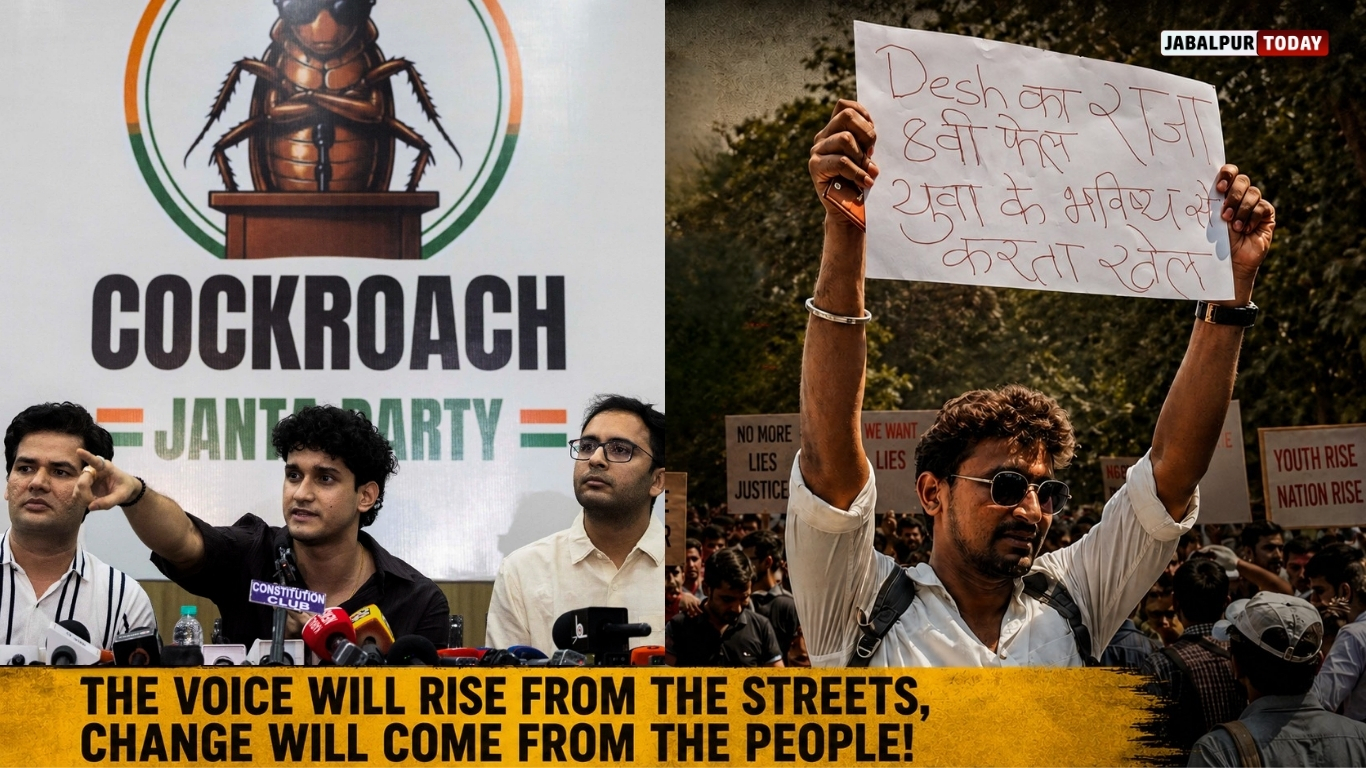
Thousands of youth protest at Jantar Mantar over the NEET 2026 paper leak, demanding Dharmendra Pradhan’s resignation and raising strong voices against the Modi government
New Delhi: Jantar Mantar, a well-known protest site in Delhi, saw a massive protest on Saturday, June 6, 2026. Thousands of young people gathered under the banner of the Cockroach Janta Party (CJP). What began as a demand for Union Education Minister Dharmendra Pradhan’s resignation over the NEET-UG 2026 paper leak quickly turned into a broader protest against the BJP-led Modi government.
Placards screamed “Dharmendra Pradhan Istifa Do,” but the energy went far broader. Protesters carried Tirangas, cockroach masks, books, and even Melody wrappers as symbols of hollow promises. Flowers were offered to police to signal peace, yet voices turned sharply personal and political against Narendra Modi and his government.
The Build-Up: From Viral Movement to Ground Zero
The CJP emerged in mid-May 2026 after Chief Justice Surya Kant’s remark comparing unemployed youth to “cockroaches.” Abhijeet Dipke, its founder, launched it as satire that struck a nerve amid youth unemployment, repeated exam leaks, and systemic despair. The NEET-UG fiasco — exam allegedly leaked and later scrapped for over 2.27 million students — along with CBSE On-Screen Marking irregularities, became the flashpoint.
Dipke flew in from the US, secured permission for a 10 AM to 5 PM gathering, and arrived at the site around 11 AM. Heavy security — over 1,000 personnel and barricades — greeted the crowd. Sonam Wangchuk, the Ladakh activist, joined later, boosting morale after Pradhan failed to resign by the June 5 deadline.
Wangchuk! Wangchuk!: A New Kind of Political Demand
Perhaps the most telling dimension of the Jantar Mantar protest on Friday was not what it was against, but what — or rather, who — it was for. In the middle of the anti-BJP sloganeering, a different kind of chant broke out, one that does not belong to the traditional vocabulary of party politics in India.
“Sonam Wangchuk! Sonam Wangchuk!” — the name of the Ladakhi climate activist, engineer, and education reformer rang out at Jantar Mantar as protesters called for him not merely as a symbol of the cause but as a leader they want to see take a place in the country’s political future. For many of those present, Wangchuk represents something that the current political establishment, whether in government or in mainstream opposition, has consistently failed to offer: authenticity.
Wangchuk’s own journey — his long fasts in the freezing cold of Ladakh, his vocal demands for the protection of Ladakh’s statehood and environment, his confrontations with Delhi’s indifference — has turned him into a figure who transcends the usual left-right or regional political divides. At Jantar Mantar on Friday, protesters from varied backgrounds, of different ages and different apparent political leanings, seemed united by the desire to see him occupy a larger national stage.
“He speaks the truth,” said one young protester, a college student who had come with a group of peers. “Woh kisi party ka banda nahi hai. Woh apne dil ki baat karta hai. Aise insaan ki zaroorat hai is desh ko.”
This demand — for Wangchuk as a leader, as a conscience, as an alternative — speaks to a broader exhaustion with conventional political choices. It is a protest within a protest: not just against the BJP, but against the entire model of politics that has left people feeling unrepresented and unheard.
Voices from the Ground: Raw Anti-Government Anger
The protest was not just anti-Pradhan. Multiple protesters voiced deep resentment toward the Modi government, with slogans and personal attacks echoing the user’s observations
An old female protester, shouting amid the crowd: “Ye sarkar Aatankwadi hai, Ye sab RSS k gunde hain! Yeh Melody khilane gya, ladki k sath ghumne, Mai Teri Rani, Tu Mera Raja” (“This government is a terrorist, they’re all RSS goons! This melody has gone to bloom, to hang out with a girl, I’m your queen, you’re my king.”)
A female student, holding a placard with Modi’s image crossed out: “Dharmendra Pradhan aur uski sarkar ko hatao! Hamara padhai, hamara career barbaad kar diya.” (Modi romances girls and enjoys honeymoons but toys with our future. Remove Pradhan and his government!)
Another youth activist, addressing fellow protesters: “Yeh BJP ki sarkar sirf jhooth bolti hai. Modi ji ne Make in India ka vaada kiya, humein Leak in India diya. Pradhan incompetent hai – istifa do! Poori government jawabdehi do!” (This BJP government only lies. Modi promised Make in India but gave us Leak in India. Pradhan is incompetent – resign! The whole government must be accountable!)
A Gen-Z participant, visibly agitated: “Modi aur Pradhan ne humare sapne chheen liye hain. Students suicide kar rahe hain, aur yeh log chup hain. Aatankwadi jaise behave kar rahe hain hamare saath. Inquilab Zindabad! Cockroaches will not stop!”
An older supporter echoing the sentiment: “Yeh government youth ko cockroach samajhti hai, lekin hum unko dikha denge. Pradhan must go, Modi sarkar bhagao! Education system ko loot rahe hain.”
These quotes reflect the shift from targeted criticism of Pradhan to broader anti-BJP and anti-Modi sentiment, including personal jabs as noted by attendees. Chants like “Dharmendra Pradhan Istifa Do! PM Modi Istifa Do!”, “Shame Shame Narendra Modi,” and “Cockroaches aa rahe hain, Pradhan jaa rahe hain” reverberated throughout the day. Many also demanded Sonam Wangchuk as a credible education leader.
Dipke himself addressed the crowd powerfully: “The youth of the country will no longer fear, they will fight. Cockroaches don’t even fear, they never die either.” He emphasized a long struggle and resilience against attempts to silence the movement online.
Wangchuk, upon arrival, reinforced the peaceful yet determined tone while praising the youth turnout as a democratic win.
Symbols, Satire, and the Human Toll
Cockroach masks reclaimed the insult. Melody wrappers appeared as satirical digs at empty governmental “sweet talk.” Posters highlighted “We asked for Make in India, you gave us Leak in India.” Stories poured out: aspirants whose years of preparation were ruined, families facing despair, and suicides linked to the pressure. The dharna felt deeply personal for many Gen Z attendees.
Counter-Voices: Criticism of the “Cockroach” Movement
Not everyone at or around Jantar Mantar supported the CJP. Counter-protesters, including groups like Hindu Raksha Dal, arrived to challenge the gathering, leading to brief tensions managed by police barricades. Some bystanders and rival voices criticized the movement harshly.
- One counter-protester remarked: “Yeh log berozgari ka rona rote hain lekin kaam karna nahi chahte. Free mein sab kuch maangte hain aur sarkar ko gaaliyan dete hain. Cockroaches ko sadak pe goli maaro – yeh desh ka kuch nahi bigaad sakte.” (They cry about unemployment but don’t want to work. They demand everything for free and abuse the government. Shoot the cockroaches on the street – they can’t harm the nation.)
- Another skeptic on the sidelines: “CJP naam ka yeh tamasha hai. Media zyada hai, protesters kam. Yeh sirf political distraction hai, asli mudde solve nahi kar rahe.” (This CJP is just a spectacle. More media than protesters. It’s a political distraction, not solving real issues.)
- Some online and on-ground dismissed the turnout as underwhelming compared to hype, with comments like “Mere Ganpati visarjan mein zyada log the” (More people at my Ganpati procession), questioning the movement’s seriousness and accusing it of being anti-national or opposition-backed. These voices highlighted divisions, with accusations of the protest being orchestrated or lacking substance.
Dipke and organizers maintained focus on peaceful, constitutional protest despite such opposition.
Broader Context and Implications
The event underscored deep youth disillusionment with education governance, unemployment, and perceived government priorities. While CJP claims non-partisanship, the day’s chants and quotes showed significant anti-BJP undercurrents. Supporters like Wangchuk and online voices (including Dhruv Rathee mentions) amplified its reach.
By evening, as the permitted time ended, the protest wound down largely peacefully, though Dipke hinted at escalation if demands went unmet. Wangchuk warned of further actions like potential hunger strikes.
This June 6 dharna marked a pivotal moment: Gen Z’s first major offline assertion via CJP. From fiery personal attacks on Modi and Pradhan to cockroach defiance and counter-criticism, it captured India’s polarized youth discourse. Whether it forces accountability or remains a one-day spectacle, the “cockroaches” have made their presence felt — loud, unapologetic, and demanding change.
