
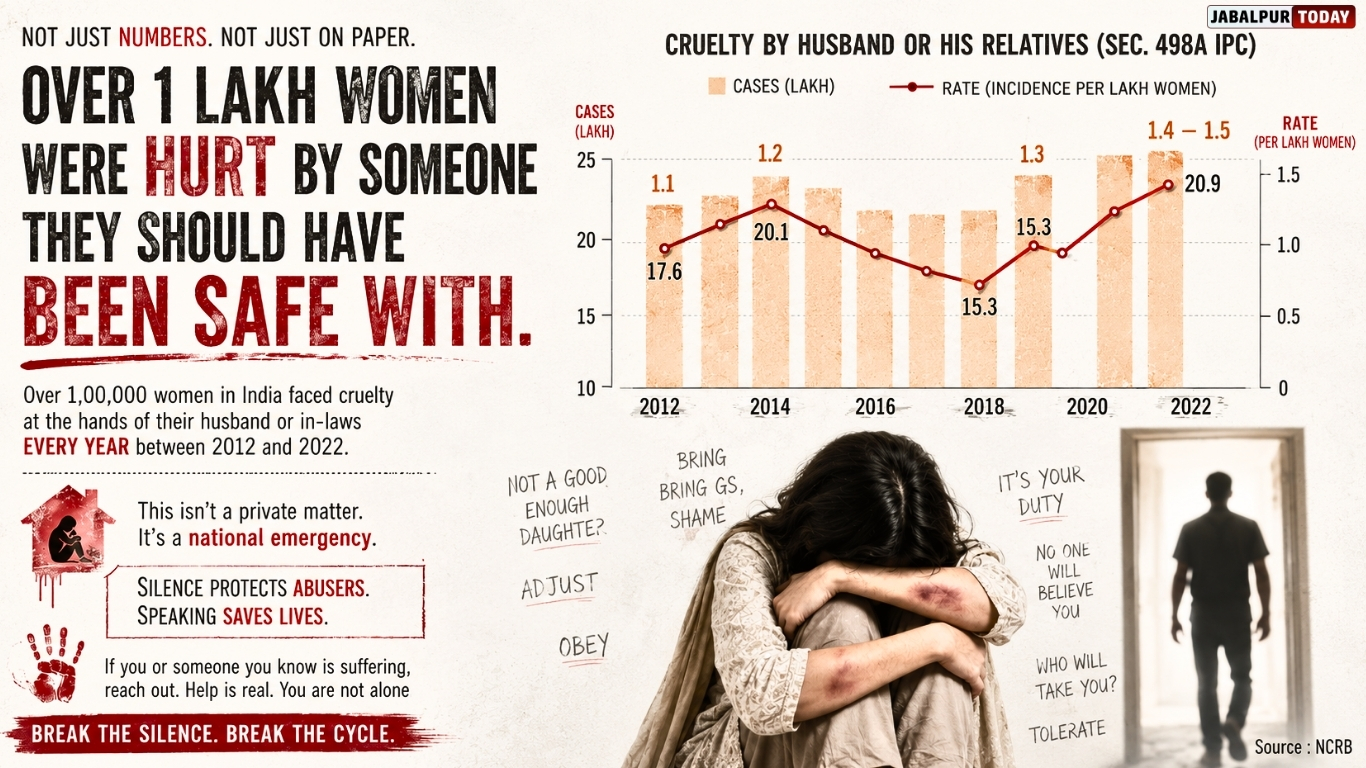
An investigative report on crimes against women, spousal violence, dowry deaths, and the silent epidemic that continues to claim thousands of lives every year
New Delhi: In the final weeks of her life, a young woman sat in a Bhopal apartment and typed message after message to her mother in Noida. “Kyu bheja mujhe yaha. Ye yaha baat he nahi kar raha hai.” “Why did you send me here? He isn’t even talking to me.” Days later, another message followed: “Mera jeevan narak ho gaya hai mummy.” “My life has become hell, Mom.”
In India, the greatest danger to many married women does not come from strangers or public spaces—it comes from inside their own homes. Cases of domestic violence, dowry harassment, and deaths linked to abuse continue to rise, exposing a deep and ongoing crisis.
Twisha Sharma — an MBA graduate, former Miss Pune, marketing professional — had married Bhopal-based lawyer Samarth Singh in December 2025, the couple having met on a dating app the previous year. Five months into that marriage, on the night of May 12, 2026, she was found hanging at her in-laws’ residence in the Katara Hills locality of Bhopal.
Her family refused to accept the official account of her death. Her mother was categorical: “We want both of them — Samarth Singh and his mother — to be arrested. They killed my daughter.” A Special Investigation Team has since been formed. Samarth’s anticipatory bail has been rejected. His mother, Giribala Singh — a retired judge — had claimed in her bail application that Twisha was addicted to drugs and suffered from behavioural difficulties. Her father countered: “The post-mortem report and evidence do not match.”
In a WhatsApp message to a friend just days before her death, Twisha had written: “Shaadi ki khujli mein shaadi mat karna. Soch samajh kar aage badhna.” “Don’t rush into marriage. Think it through carefully.”
She had seen enough to warn others. She would not get the chance to say more.
Less than a year before Twisha’s death, another woman lay dying in a hospital bed in Delhi with 70 per cent burns. Nikki Bhati, 26 years old, a beauty influencer and parlour owner from Greater Noida’s Sirsa village, had been beaten, doused with a flammable substance, and set on fire inside her own home on August 21, 2025 — allegedly by her husband Vipin Bhati and members of his family. She died en route to Safdarjung Hospital.
Her five-year-old son had witnessed the attack.
Nikki and her sister Kanchan had both married into the Bhati family in 2016. For nearly nine years, according to her family, she had endured relentless harassment — escalating dowry demands that totalled ₹36 lakh, abuse over her beauty parlour income, and violence triggered by her Instagram reels. Even a Scorpio vehicle and a motorcycle provided by her family had not been enough. When police arrested Vipin, he showed, investigators said, complete lack of remorse. “She died on her own,” he reportedly told police.
All four members of the Bhati family — husband, wife’s mother-in-law, father-in-law, and brother-in-law — have since been arrested. The National Commission for Women intervened. #JusticeForNikki trended nationally. And yet, cases like Nikki’s and Twisha’s are not exceptions.
They are, devastatingly, the norm.
The Numbers Behind the Headlines
India’s National Crime Records Bureau (NCRB) is one of the most comprehensive databases of crime in the world. And what it reveals about the safety of married women inside their own homes is staggering.
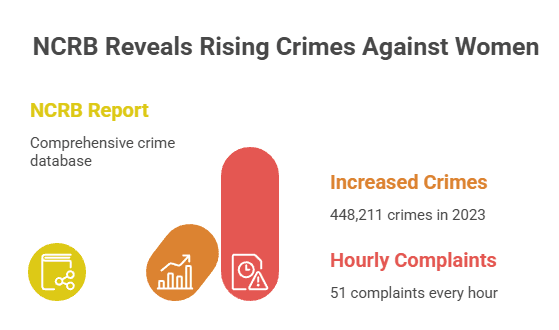
In 2022, India recorded 4,45,256 crimes against women — a 4 per cent increase over the 4,28,278 cases registered in 2021, and a sharp climb from 3,71,503 in 2020. The NCRB’s 2023 report shows this trajectory continued: 4,48,211 crimes against women were recorded in 2023 alone, averaging 51 complaints every hour.
But among all these categories of crime, one dominates every single year — consistently, crushingly, without exception.
Cruelty by Husband or His Relatives
In 2022, this category accounted for 31.4 per cent of all crimes against women — over 1,40,000 cases registered under Section 498A of the Indian Penal Code. In 2023, the figure stood at 1,33,676 cases, representing 29.8 per cent of the total. Research spanning 2017 to 2023 confirms that domestic violence, as reflected through this single legal provision, remained “the most prevalent and fastest-growing category” of crime against women across the entire study period.
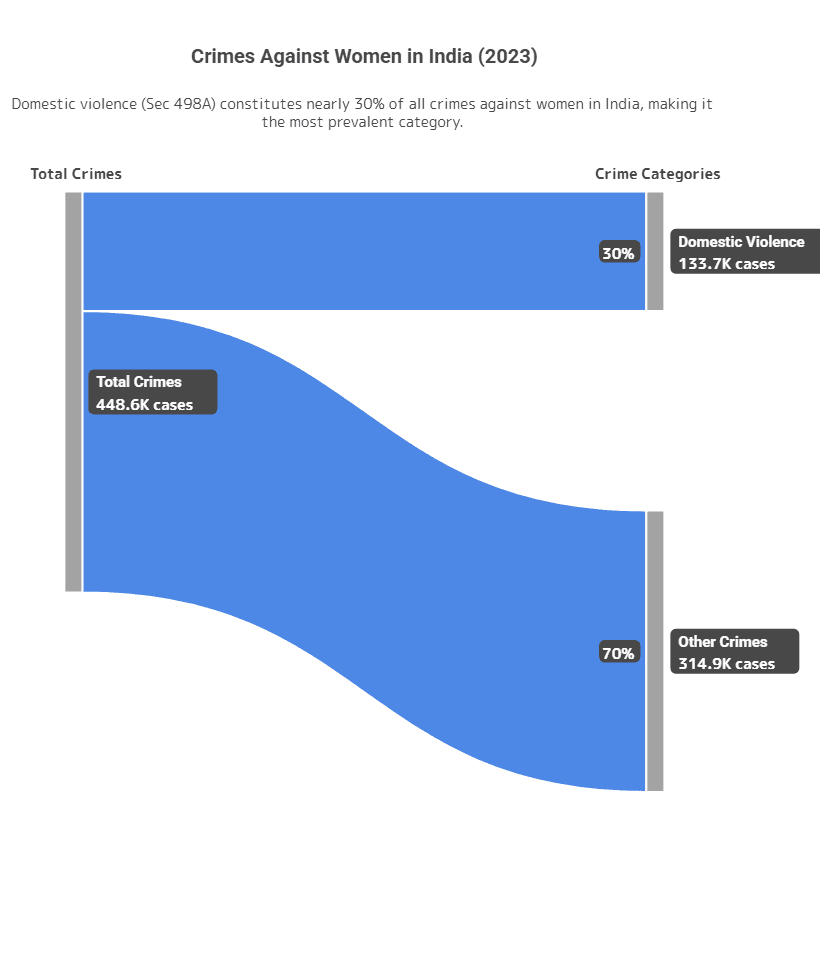
To put it plainly: the single most dangerous threat to an Indian woman is not a stranger on the street. It is the man she married, and the family she married into.
The Dowry Death Epidemic
At the most lethal end of this spectrum lies the crime of dowry death.
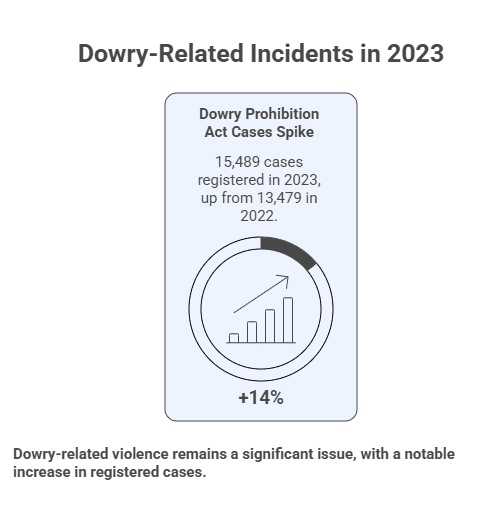
In 2023, 6,156 women lost their lives in dowry-related incidents — an average of nearly 17 deaths per day, or one roughly every 85 minutes. Dowry was cited as the explicit motive in an additional 833 murder cases. Under the Dowry Prohibition Act, 15,489 cases were registered in 2023 — a 14 per cent spike from the 13,479 registered in 2022.
Between 2017 and 2022 alone, 35,493 dowry deaths were reported — an average of 20 a day, every day, for six consecutive years.
Uttar Pradesh leads this grim accounting with 2,122 dowry deaths in 2023. Bihar follows with 1,143. These two states, along with Madhya Pradesh and Rajasthan, together account for nearly 65 per cent of India’s dowry deaths.
The NCRB’s own data reveals a statistic that puts the scale in context: in 2022, dowry deaths were more than 25 times higher than the number of women killed following rape or gang rape. India’s most publicised category of gender-based crime is dwarfed — in body count — by what happens inside matrimonial homes.
And yet, this epidemic receives a fraction of the outrage.
The Justice Gap: When Conviction Becomes an Exception
If the numbers of dowry deaths are shocking, the conviction rates are damning.
NCRB’s Crime in India 2022 report pegs conviction rates in dowry-related violence cases at a mere 11 to 17 per cent across states. In Uttar Pradesh, which reported 2,200 dowry death cases in 2022, only 320 resulted in conviction — a rate of 14.5 per cent. Delhi, with 180 reported cases, saw only 20 convictions — just 11 per cent.
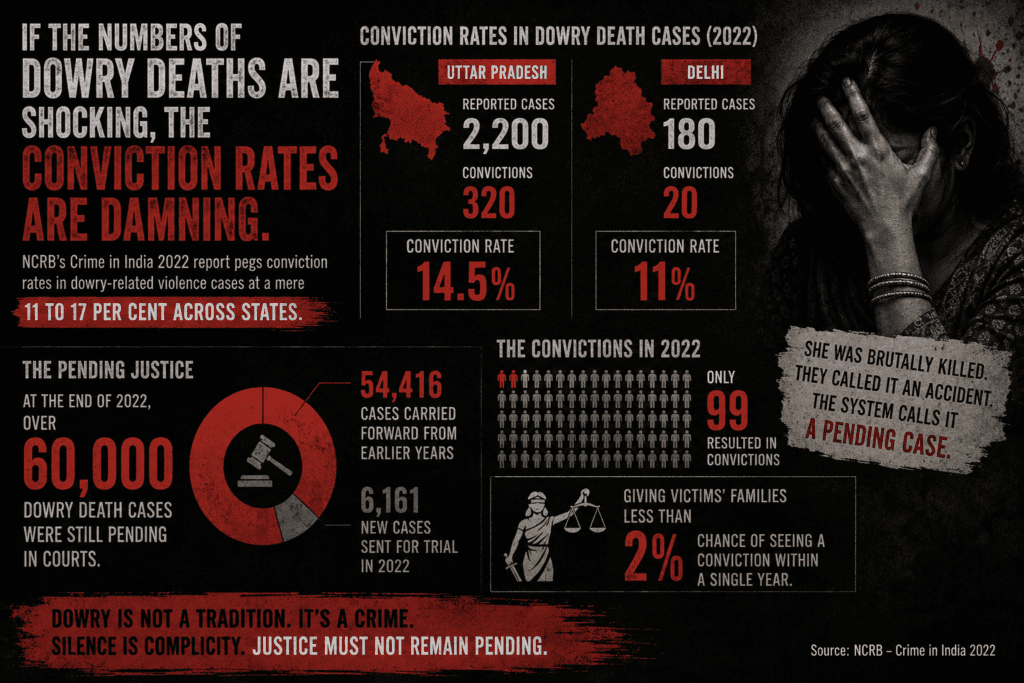
At the end of 2022, over 60,000 dowry death cases were still pending in courts, with 54,416 carried forward from earlier years. Of 6,161 new cases sent for trial in 2022, only 99 resulted in convictions — giving victims’ families less than a 2 per cent chance of seeing a conviction within a single year.
Legal experts and advocates point to a systemic failure: evidentiary hurdles, police apathy, hostile witnesses, intimidated victims, and trials stretching beyond five years. Economic and psychological cruelty — the sustained emotional destruction of a woman through isolation, financial control, and humiliation — leaves almost no forensic trail. Dying declarations, often the only record of a woman’s final testimony about who harmed her, must pass rigorous tests of reliability in courts. Many do not.
A December 2025 Delhi court ruling captured the environment succinctly. Refusing bail to a husband accused of driving his wife to suicide within four months of their wedding, Additional Sessions Judge Hargurvarinder Singh Jaggi wrote that the case revealed “a disturbing pattern of cruelty and dowry-related harassment.” The woman, Reena, had left behind a handwritten suicide note explicitly naming her husband and sister-in-law. Yet the defence had attempted to discredit her by alleging she had developed a relationship with her brother-in-law. The court rejected this, stating: “Such assertions border on character assassination of a deceased woman who was no longer alive to defend herself.”
Every 10 Minutes: The Global Picture
India’s crisis does not exist in isolation. It is part of a global pattern that the United Nations has described in the starkest possible terms.
In November 2025, the United Nations Office on Drugs and Crime (UNODC) and UN Women released their annual femicide report with a finding that should stop the world cold: in 2024, 50,000 women and girls were killed by intimate partners or family members — one every ten minutes, 137 every day. These killings accounted for 60 per cent of all intentional female homicides worldwide.
By comparison, intimate partners or family members killed only 11 per cent of male homicide victims during the same period.
“The home remains a dangerous and sometimes lethal place for too many women and girls around the world,” said John Brandolino, acting Executive Director of UNODC. UN Women’s Sarah Hendriks added that femicides “often sit on a continuum of violence that can start with controlling behaviour, threats, and harassment — including online.”
Africa recorded the highest rate of intimate partner femicide globally, followed by the Americas, Oceania, Asia, and Europe. But in Europe, intimate partners murdered a striking 64 per cent of the women who were killed.
India, whose dowry deaths alone place it at the top of global rankings for this category, is a significant contributor to Asia’s share of this crisis. These parallels are not coincidental: spousal violence leads gender-based violence in India and follows global trends, while patriarchy, economic dependence, social stigma, and weak institutional response actively enable violence in Indian homes—just as they do in societies around the world.
Nearly One in Three: The NFHS Data
The NCRB data captures reported crimes — the visible fraction of a far larger reality.
The National Family Health Survey (NFHS-5), conducted between 2019 and 2021, found that 32 per cent of ever-married women in India had experienced physical, sexual, or emotional violence at the hands of their husbands during their lifetimes. A more targeted figure: 29.3 per cent of married women between the ages of 18 and 49 reported experiencing spousal violence.
This figure — nearly one in three — far exceeds what the NCRB captures in its crime data. The divergence exposes a profound truth: the majority of women subjected to domestic violence in India never file a complaint. Cultural stigma, family pressure, economic dependence, fear of retaliation, distrust of law enforcement, and the deeply ingrained social imperative to preserve the marriage — all of these conspire to keep violence hidden.
According to NFHS data, a significant proportion of both men and women in India believe that a husband has the right to beat his wife under certain circumstances. This normalisation of violence within marriage is not a fringe phenomenon — it is embedded in the social fabric of households across income levels, castes, and regions.
The National Commission for Women (NCW) Annual Report 2023-24 recorded 28,650 complaints across multiple categories, with the highest numbers under the Right to Live with Dignity (8,271), Protection Against Domestic Violence (6,487), and Harassment of Married Women/Dowry Harassment (4,815).
The Legal Architecture: What the Law Says
India has built one of the more extensive legislative frameworks in the world for the protection of women within marriage. The tragedy is how consistently it fails in implementation.
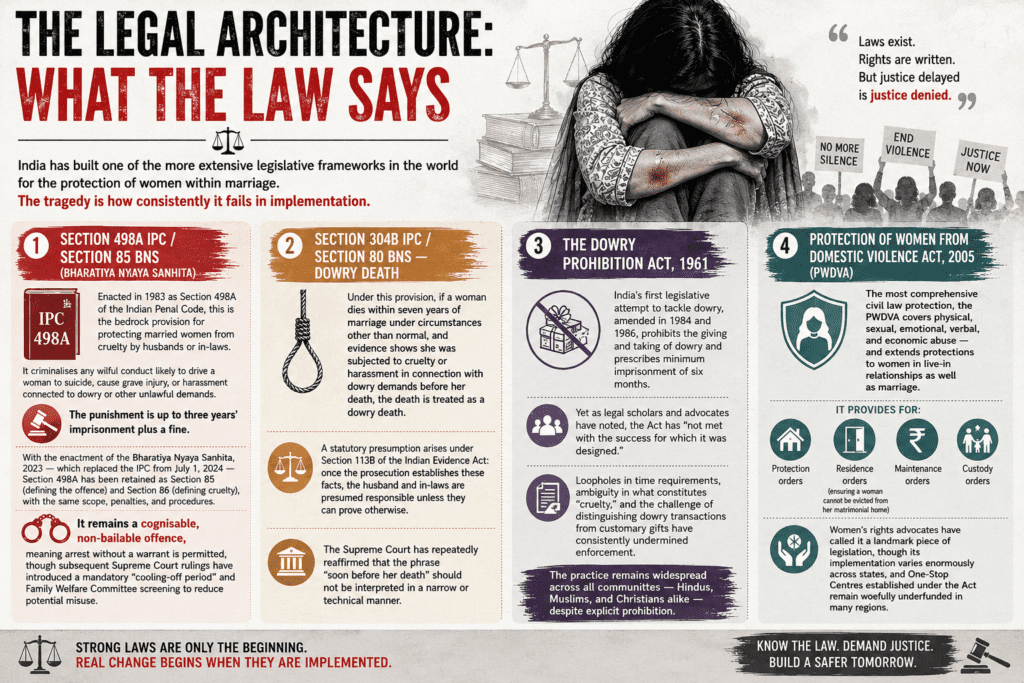
Section 498A IPC / Section 85 BNS (Bharatiya Nyaya Sanhita)
Enacted in 1983 as Section 498A of the Indian Penal Code, this is the bedrock provision for protecting married women from cruelty by husbands or in-laws. It criminalises any wilful conduct likely to drive a woman to suicide, cause grave injury, or harassment connected to dowry or other unlawful demands. The punishment is up to three years’ imprisonment plus a fine.
With the enactment of the Bharatiya Nyaya Sanhita, 2023 — which replaced the IPC from July 1, 2024 — Section 498A has been retained as Section 85 (defining the offence) and Section 86 (defining cruelty), with the same scope, penalties, and procedures. It remains a cognisable, non-bailable offence, meaning arrest without a warrant is permitted, though subsequent Supreme Court rulings have introduced a mandatory “cooling-off period” and Family Welfare Committee screening to reduce potential misuse.
Section 304B IPC / Section 80 BNS — Dowry Death
Under this provision, if a woman dies within seven years of marriage under circumstances other than normal, and evidence shows she was subjected to cruelty or harassment in connection with dowry demands before her death, the death is treated as a dowry death. A statutory presumption arises under Section 113B of the Indian Evidence Act: once the prosecution establishes these facts, the husband and in-laws are presumed responsible unless they can prove otherwise. The Supreme Court has repeatedly reaffirmed that the phrase “soon before her death” should not be interpreted in a narrow or technical manner.
The Dowry Prohibition Act, 1961
India’s first legislative attempt to tackle dowry, amended in 1984 and 1986, prohibits the giving and taking of dowry and prescribes minimum imprisonment of six months. Yet as legal scholars and advocates have noted, the Act has “not met with the success for which it was designed.” Loopholes in time requirements, ambiguity in what constitutes “cruelty,” and the challenge of distinguishing dowry transactions from customary gifts have consistently undermined enforcement. The practice remains widespread across all communities — Hindus, Muslims, and Christians alike — despite explicit prohibition.
Protection of Women from Domestic Violence Act, 2005 (PWDVA)
The most comprehensive civil law protection, the PWDVA covers physical, sexual, emotional, verbal, and economic abuse — and extends protections to women in live-in relationships as well as marriage. It provides for protection orders, residence orders (ensuring a woman cannot be evicted from her matrimonial home), maintenance, and custody orders. Women’s rights advocates have called it a landmark piece of legislation, though its implementation varies enormously across states, and One-Stop Centres established under the Act remain woefully underfunded in many regions.
The Most Famous Cases: A Pattern of Power and Impunity
India has witnessed a series of high-profile spousal and in-law violence cases that have sparked national outrage — and each follows recognisably similar contours.
- Nikki Bhati, Greater Noida, August 2025: Married in 2016 into the Bhati family alongside her sister. Nine years of alleged dowry harassment, financial extortion, and domestic violence. Set on fire by her husband, dying from 70 per cent burns. Her five-year-old son witnessed the attack. Her husband, upon arrest, showed no remorse and claimed “she died on her own.” Husband Vipin Bhati was shot while attempting to flee police. All four family members arrested. NCW intervened. Case highlighted the double vulnerability of women married into families with histories of violence.
- Twisha Sharma, Bhopal, May 2026: MBA graduate, former Miss Pune, marketing professional. Married a lawyer, found dead five months later. Family alleges dowry harassment and murder. SIT formed, anticipatory bail of husband rejected. Husband’s mother — a retired judge — accused in bail application of defaming the deceased by alleging drug addiction. Case drew attention to the vulnerability of educated, professionally accomplished women within matrimonial homes.
- Reena, Delhi, July 2025: Married in March 2025, found dead four months later. Handwritten suicide note naming husband and sister-in-law. Court refused bail to husband, citing “disturbing pattern of cruelty.” Case cited in Supreme Court jurisprudence on dowry deaths and the interpretation of “soon before her death.”
These cases represent the visible surface of a submerged crisis. For every case that trends nationally, hundreds more are buried in police stations, settled by family panchayats, or recorded as “accidental deaths.”
Underreporting: The Submerged Crisis
Perhaps the most alarming aspect of India’s domestic violence data is not what it shows — but what it conceals.
India’s law enforcement records cases that are formally reported. The NFHS captures self-reported experiences. The gap between the two is enormous and deliberate — not the result of data failure, but of social architecture designed to suppress disclosure.
Women who report abuse to police frequently encounter disbelief, discouragement, or active pressure to “compromise.” Many are told that domestic disputes are “family matters.” Returning to the matrimonial home after filing a complaint can expose a woman to greater danger. Economic dependence makes leaving impossible for millions. And in a social environment where divorce remains heavily stigmatised — particularly for women — many endure violence in silence to preserve their children’s futures, their family’s honour, or their own social standing.
Dowry deaths specifically are subject to systematic misclassification. Because they occur inside the home, with the family as the only witnesses, they are frequently recorded as suicides, kitchen accidents, or natural deaths. Forensic experts have noted that dying declarations — often the only evidence a victim can leave — must be taken in environments free from family coercion, a requirement rarely met in practice.
The result: experts widely believe that NCRB figures represent a fraction of actual incidence. When one in three married women self-reports domestic violence but NCRB records only one in six as a formal complaint, the dark number is vast and unknowable.
Regional Disparities: Where Risk Is Highest
Crimes against women are not distributed equally across India’s geography. Regional patterns reveal how economic development, urbanisation, social norms, and law enforcement effectiveness intersect.
The Northern zone recorded the highest crime rate against women in 2022 — 88.77 per 100,000 female population — substantially exceeding the national average of 66.4. Delhi registered a rate of 144.4, Haryana 118.7, and Telangana 117.6. Rajasthan (114.8) and Odisha (112.4) also recorded rates far above the national average.
Uttar Pradesh dominates dowry crime statistics: 7,151 cases under the Dowry Prohibition Act in 2023, and 2,122 dowry deaths. Bihar follows with 3,665 cases and 1,143 deaths. These two states together account for more than half of India’s dowry-related fatalities.
Meanwhile, 13 states and Union Territories — including West Bengal, Goa, Arunachal Pradesh, Ladakh, and Sikkim — reported zero dowry cases in 2023. Whether this reflects genuine absence of the crime or systematic non-reporting and non-registration is a matter of significant debate among researchers and advocates.
The Legal Battles Still to Be Won
Despite decades of legislation, several significant gaps remain in India’s legal framework for protecting married women.
Marital Rape: India remains one of only a handful of countries in the world where marital rape is not a criminal offence. Exception 2 to Section 375 of the IPC historically excluded sexual assault by a husband from the definition of rape — a carve-out that advocates have challenged for years. The issue reached the Supreme Court, with the government arguing that criminalising marital rape could “destabilise the institution of marriage.” As of 2025, marital rape remains outside the ambit of criminal law, leaving women with no recourse for sexual violence within marriage except the limited civil remedies under the PWDVA.
Pendency and Delay: Over 60,000 dowry death cases were pending in courts at the end of 2022, with an additional 83,327 cases under trial under the Dowry Prohibition Act in 2023. Trial completion averages more than five years. Fast-track courts established for gender-based crimes have made inroads but remain insufficient in number and resources.
498A Debates: Section 498A — now Section 85 BNS — has faced criticism from some quarters for alleged misuse, with the Supreme Court in earlier rulings expressing concern about “legal terrorism” through false cases. The resulting introduction of Family Welfare Committees and cooling-off periods has, in the view of women’s rights advocates, created additional barriers for genuine victims to access justice. The data, however, shows that conviction rates remain abysmally low, suggesting the system systematically under-convicts rather than over-prosecutes.
One-Stop Centres: Established under the Nirbhaya Fund to provide integrated support to survivors — medical, legal, psychological, and shelter — One-Stop Centres remain underfunded and unevenly distributed. In many states, there are fewer than a dozen functioning centres.
What Structural Reform Requires
Legal scholars, advocates, and survivors’ families consistently identify the same cluster of structural failures — and the interventions required to address them.
Police Reform: Women must be able to report domestic violence without being told it is a “family matter.” Mandatory registration of FIRs in domestic violence cases, female officers of senior rank involved in all investigations, and dedicated domestic violence units in all districts are minimum requirements.
Fast-Track Justice: With conviction rates between 11 and 17 per cent and trials lasting five-plus years, the justice system provides impunity rather than deterrence. Dedicated fast-track courts for dowry and domestic violence cases, with time-bound trial completion mandates, are essential.
Economic Independence: Research consistently shows that women with economic independence are better positioned to leave abusive relationships and survive separation. Access to bank accounts, property rights, financial literacy, and employment opportunities are structural interventions with direct safety implications.
Social and Educational Change: Legal change without social change delivers limited results. As long as dowry is treated as a social norm — with families saving from a daughter’s birth to fund her departure — the structural conditions for dowry-related violence will persist. School curricula, community mobilisation, and sustained public campaigns that challenge the commodification of daughters are not supplementary initiatives. They are central to any strategy.
Data and Accountability: India needs better cross-referencing of NCRB data with judicial records, forensic data, and civil registration systems to understand the true scale of dowry deaths and domestic violence fatalities. Misclassification of dowry deaths as accidents or suicides must be treated as a systemic failure with accountability consequences for investigating officers.
A System That Counts Bodies, Not Lives
In a conversation with a friend days before her death, Twisha Sharma wrote: “I have been under anxiety because I am sitting at home. I want to do something with my life.”
She wanted to work. She wanted purpose. Also She wanted to exist as something more than an appendage to a marriage. She sent warnings to her friend. Then She sent distress signals to her mother. She left a record of her suffering in digital form — the modern equivalent of the dying declarations that courts scrutinise so carefully, except these were written while she was still alive.
NCRB’s 2023 report records 4,48,211 crimes against women. Of those, the largest category — the one that crushes all others by volume — is cruelty by husbands and their relatives. Over 1,30,000 women filed complaints. Millions more did not.
The UN has told the world that a woman is killed by someone she knows, someone in her own home, every ten minutes. In India, that pattern is amplified by a culture of dowry, an economy of dependence, a justice system stretched to breaking, and a social silence that still tells women to adjust, to tolerate, to endure.
The data is available. The patterns are documented. The cases are on record — Nikki Bhati, Twisha Sharma, Reena, and thousands more who did not make the national news cycle.
The question is not what is happening to married women in India. The data is clear.
The question is what India chooses to do with that knowledge.

Mansi Sharma is a journalist covering Global Affairs, and wellness, known for turning complex ideas into sharp, engaging narratives. Her work is driven by curiosity, depth, and a constant urge to question and explore. When she’s not writing, you’ll often find her diving into new ideas—preferably with a cup of coffee in hand, one sip at a time.