
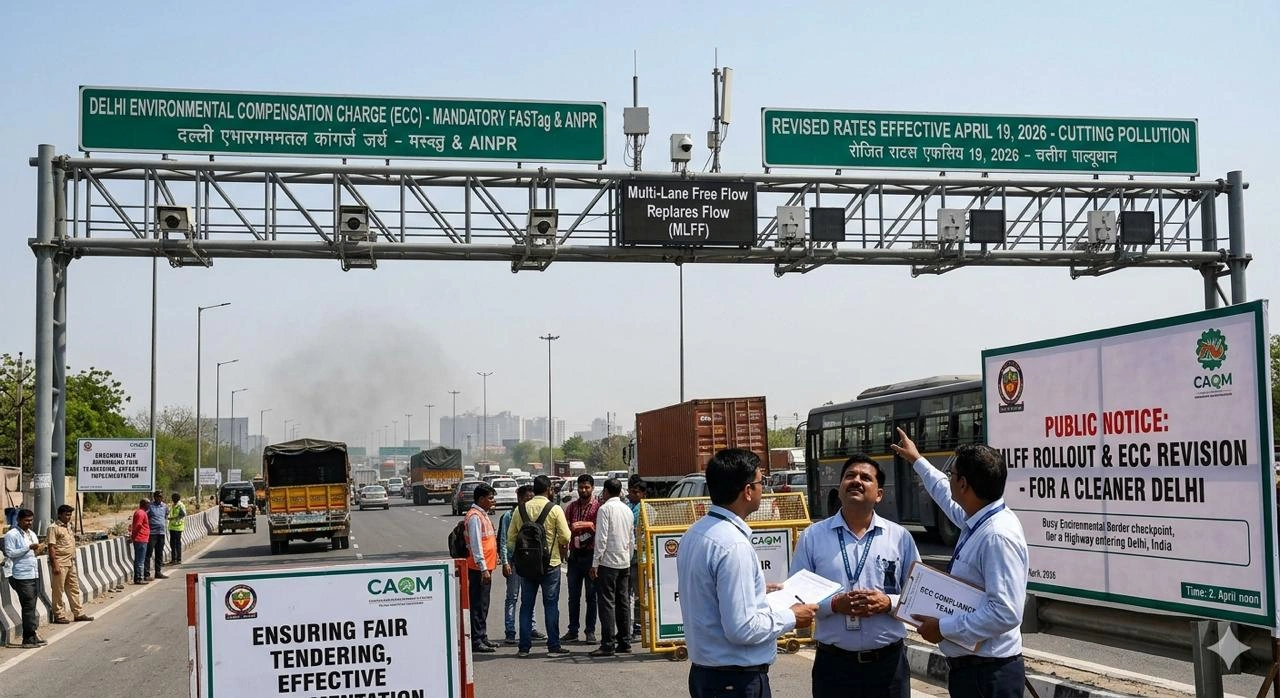
Higher ECC rates and barrier-free tolling aim to cut pollution, but fair and competitive bidding remains key to effective implementation
New Delhi, April 24, 2026:
In a major push to curb vehicular pollution, recent directions from the Supreme Court in the M.C. Mehta v. Union of India case have cleared the way for a stronger Environment Compensation Charge (ECC) system for commercial vehicles entering Delhi. Acting on recommendations from the Commission for Air Quality Management (CAQM), the Court has termed the revised ECC framework “reasonable, just and fair.”
Under the new framework, ECC rates will increase by 50%, with an additional 5% annual hike. These changes will come into effect from April 19, 2026, and aim to discourage unnecessary entry of polluting vehicles into the capital.
At the same time, the Municipal Corporation of Delhi (MCD) plans to roll out Multi-Lane Free Flow (MLFF) tolling. This system will enable seamless, barrier-free toll and ECC collection using FASTag and automated number plate recognition technology. The move will reduce congestion, improve compliance, and align Delhi with national tolling reforms led by the National Highways Authority of India (NHAI). It will also turn ECC into a more effective economic deterrent against pollution.
However, past experience highlights the need for caution. In February 2024, an MCD tender for toll operations included highly restrictive eligibility criteria. It required bidders to have operated 122 toll lanes in a single contract for two continuous years. These conditions excluded most potential participants, resulting in only two bidders. Limited competition affected price discovery and eventually led to the cancellation of the tender. The Delhi High Court also stressed the importance of balanced and rational eligibility norms.
Industry analysis shows that very few projects in India meet such stringent criteria, making them inherently exclusionary.
As Delhi moves ahead with ECC enforcement and MLFF implementation, the success of these initiatives will depend not only on strong policy decisions and advanced technology but also on fair and competitive tendering processes. Ensuring open participation and avoiding restrictive norms will be critical to maintaining transparency, maximizing public revenue, and achieving the environmental goals set by the Court.
