
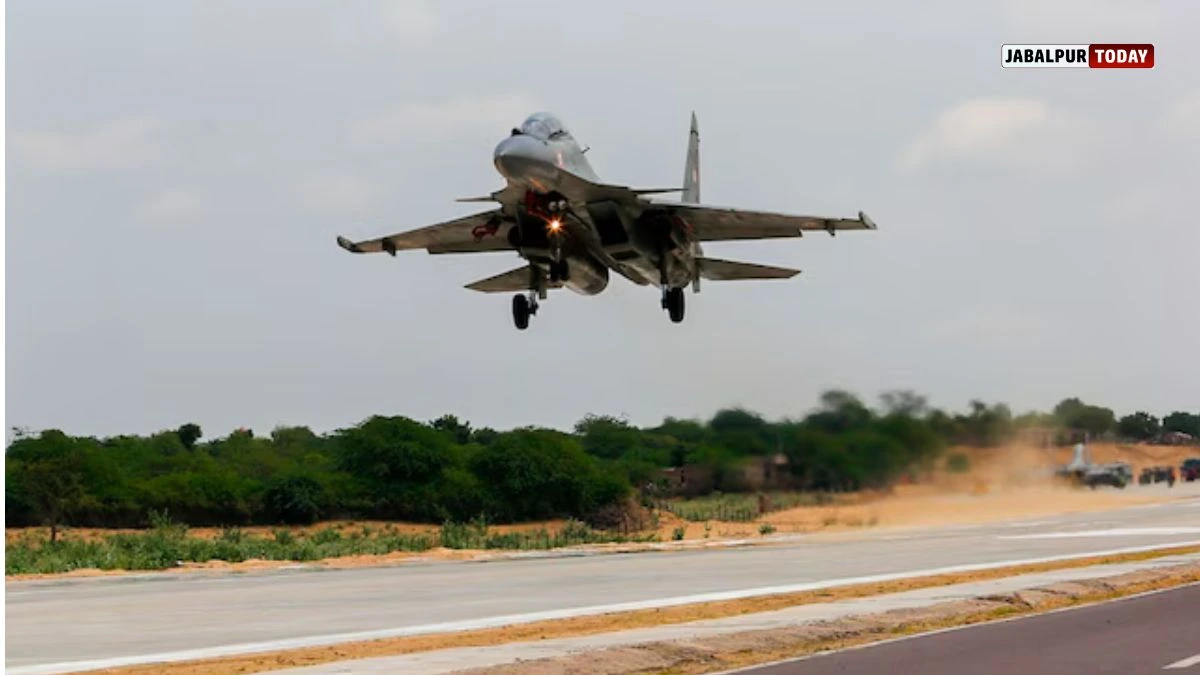
Uttar Pradesh: On the morning of April 22,one of India’s newest expressways. Fighter jets passed quickly through a stretch of highway normally used by trucks and families on road trips, landed with precision, and roared back into the sky. For two full days, a 3.2-kilometre section of the Purvanchal Expressway in Uttar Pradesh’s Sultanpur district was not a road — it was a military air base.
The Indian Air Force’s exercise here is the latest, and most ambitious, demonstration of a strategic idea that defence planners have been quietly building for years: using India’s expanding network of expressways as emergency military runways. It was impossible to ignore this message emerging from the thundering and jet smoke.
Two Days That Turned a Highway into a Base
The airstrip near Arval-Kiri Karwat village wasn’t improvised. A dedicated 3.2-kilometre stretch had been engineered from the beginning to withstand the weight, speed, and stress of military aircraft—a feature embedded into the expressway’s design itself.
Over the two-day exercise, fighter jets performed take-offs and high-speed touch-and-go landings. Transport aircraft delivered personnel and supplies, while helicopters hovered overhead to insert special forces units. For all practical purposes, the highway became a fully functional air base—one that simply serves civilian traffic on normal days.
What Made This Exercise Stand Out
This wasn’t a symbolic drill—it was a full-spectrum combat simulation involving some of the Air Force’s most capable aircraft.
Fighter jets included:
- Sukhoi Su-30MKI
- Dassault Mirage 2000
- SEPECAT Jaguar
- HAL Tejas
Transport and support aircraft:
- Airbus C-295
- Antonov An-32
- Mil Mi-17
On the ground, elite Garud Commando Force units conducted insertion and security operations.
The C-295’s landing stood out. As a relatively new addition to the fleet, its performance on a highway—far from a conventional runway—highlighted the growing versatility of India’s transport capabilities. Meanwhile, the Tejas landing carried symbolic weight: an indigenously built fighter proving itself in an unconventional, real-world scenario.
Why the IAF Trains for Highway Operations
To understand the importance of such drills, consider the opening hours of modern warfare. Airbases are among the first targets. Runways can be cratered, fuel depots hit, and operations disrupted.
If an air force depends only on fixed bases, it becomes predictable—and vulnerable.
Highway airstrips break that vulnerability.
They are:
- Dispersed across regions
- Harder to identify and target simultaneously
- Capable of being activated quickly
This is the logic behind India’s growing network of Emergency Landing Facilities (ELFs)—highway stretches designed to function as backup runways when traditional airbases are compromised.
These airstrips also serve civilian purposes. In disasters like earthquakes or floods, they allow relief aircraft to land closer to affected areas, speeding up response time.
What It Takes to Run a Highway Air Base
Transforming a highway into an air base is no small task.
For this exercise:
- A 12-kilometre stretch of the expressway was sealed
- Civilian traffic was diverted for several days
- Hundreds of security personnel were deployed
- Public access was completely restricted
Night operations added another layer of complexity. Landing high-speed fighter jets on a highway with minimal lighting—and without the navigational support of permanent airbases—requires exceptional pilot skill and precise coordination.
The successful execution across multiple aircraft types, in both day and night conditions, reflects extensive planning and training.
Part of a Larger National Strategy
The Purvanchal Expressway is not an isolated case—it’s part of a broader shift in India’s defence infrastructure.
Similar airstrip-enabled highways include:
- Agra–Lucknow Expressway
- Ganga Expressway
Other states are also integrating such features into new projects.
These airstrips are designed during the construction phase itself, adding minimal cost but offering major strategic advantages. This reflects a shift toward dual-use infrastructure—assets that serve both civilian and military purposes.
Countries like Sweden, Finland, and Taiwan have long followed this model. India is now scaling it up significantly.
Reading the Signal
Military exercises are never just about training—they also communicate intent.
This drill sent a clear message:
- India can operate its air power from dispersed, unconventional locations
- Striking conventional airbases will not cripple its capabilities
- There is no single point of failure
It also sends an internal signal—to policymakers and the public—that the military is adapting, investing in resilience, and preparing for complex, modern warfare scenarios.
A Road with Two Identities
For now, the Purvanchal Expressway isn’t returning to normal just yet. A 12-kilometre stretch will remain closed to civilian traffic until May 1, 2026, with operations expected to resume from May 2.
When it does reopen, it will carry an invisible second identity.
It will once again serve trucks, buses, and daily commuters—but it will also stand ready as a military runway. A civilian road, proven capable of supporting war.
