
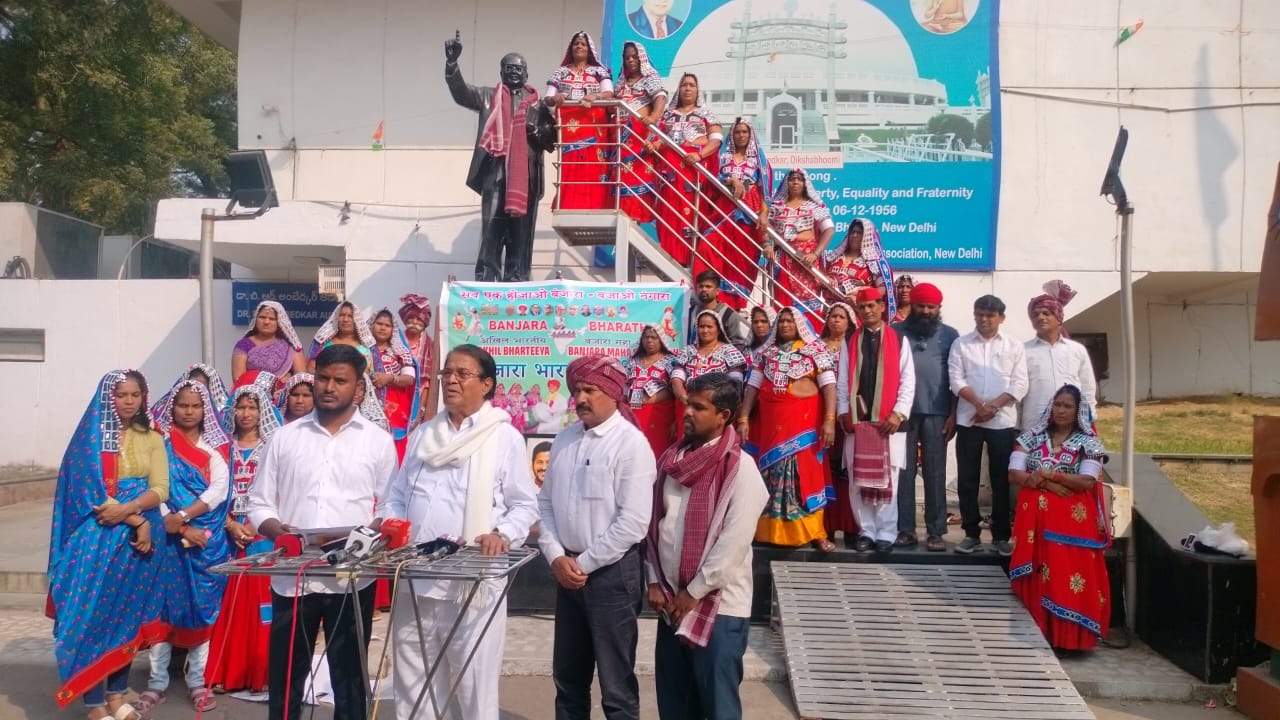
Banjara organisations launch a nationwide movement in Delhi, highlighting historical injustices, cultural preservation needs and constitutional recognition, while urging the government to address long-pending developmental and social concerns.
New Delhi, 29 November 2025
A major mobilisation of the Banjara community took place in the national capital today with the official poster launch of the “Hello Banjara – Chalo Dilli / Delhi Aao Banjara – Bajao Nangara” campaign. Led by Banjara Bharat and the recently formed Akhil Bharatiya Banjara Maha Seva Sangh, the event united delegates from various states to spotlight historic neglect and present a structured set of national demands.
Addressing the gathering, former MP and Patron–Chairman of the Banjara Bharat organisation Ravindra Naik emphasised that even after more than 80 years of independence, Banjara settlements—spread across nearly twenty states—continue to struggle for essential services such as potable water, all-weather roads, electricity, healthcare and accessible education.
He noted that although the community shares a cohesive cultural identity, its fragmented classification under SC, ST, OBC and VJNT categories across states has resulted in uneven constitutional protections, leaving the community politically underrepresented despite its presence in almost 200 Lok Sabha and 1,000 Vidhan Sabha constituencies.
The programme also paid tribute to the remarkable legacy of Lakki Shah Banjara, whose expansive 350-acre Tanda once stood where Raisina Hills is located today. The organisers reiterated the long-pending issue of unresolved land compensation, stating that only a fraction of the promised settlement was ever provided when the land was taken over for national institutions such as Rashtrapati Bhavan and the Parliament House.
Community representatives called on the government to safeguard heritage zones linked with Banjara history, including Lohagarh (Haryana), Mangarh (Rajasthan), Lakhi Sarai (Bihar), Mathura–Vrindavan (Uttar Pradesh), Sagar Lakki Shah Lake (Madhya Pradesh), Banjara Hills and Golconda Gate (Telangana), Baba Hathiram Math (Tirupati) and Kadambur Hills (Tamil Nadu).
Among the foremost demands was the inclusion of Banjara/Gor Boli in the Eighth Schedule of the Constitution, reinforcing the resolution already passed by the Telangana Legislative Assembly. The community also proposed granting uniform national recognition to all sixteen Banjara sub-groups to remove statewise inconsistencies and uphold the principle of “One Nation, One Banjara.”
The charter further sought the creation of a National Banjara Tanda–Nagla–Dera Development Board to guarantee basic services in Banjara habitations nationwide. The organisations also appealed for the establishment of a National Banjara Museum and National Banjara University in Delhi and Hyderabad to promote cultural studies, historical research and educational advancement.
With many Banjara youth engaged in itinerant livelihoods and informal hawking, leaders highlighted the need for official identity cards and structured protective mechanisms to prevent harassment and exploitation in urban areas.
Focusing on women’s empowerment, the community proposed setting up 200 Banjara Women’s Residential Schools at district headquarters to overcome low literacy rates. Additional demands included naming key NCR roads after Banjara icons, forming a National Banjara Research and Development Commission, installing statues of Lakki Shah Banjara and Makkan Shah Lubana in the Parliament complex, launching a national train named “Banjara Bharat Rail,” and establishing a Banjara Regiment recognising the community’s long martial tradition.
The event ended with a strong appeal for unity and determined collective action, as organisers urged the central government to resolve these pending historical, cultural and developmental issues without delay.
