
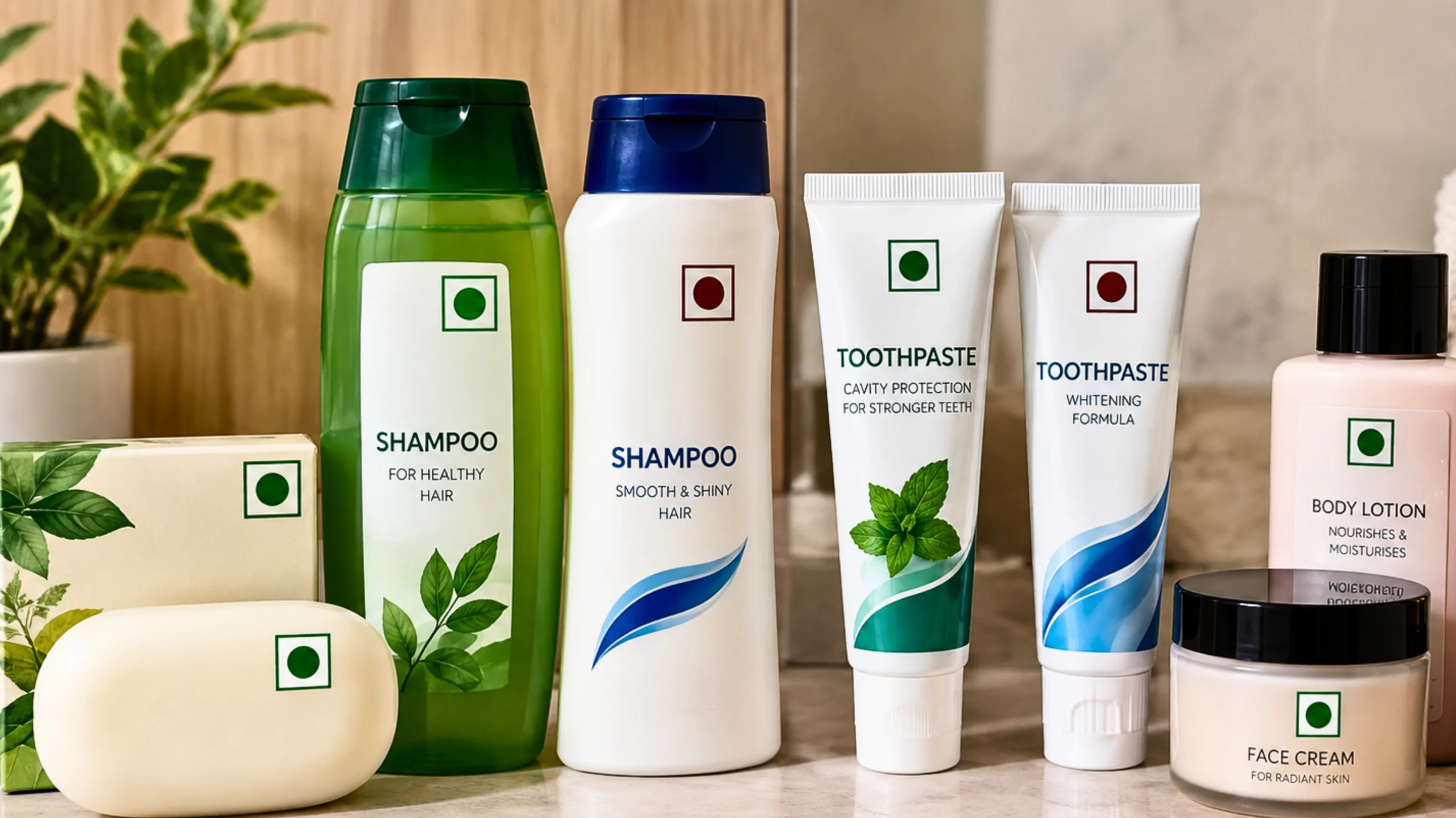
The government has reaffirmed a decade-old labelling requirement, giving consumers a clearer way to identify animal-derived ingredients in personal-care products
New Delhi: Indian consumers will now find it easier to know whether their soap, shampoo, toothpaste and other personal-care products contain ingredients that come from animals.
On September 21, 2026, the Central Government notified the Legal Metrology (Packaged Commodities) Fourth Amendment Rules, 2026. The new amendment requires soaps, shampoos, toothpastes, cosmetics and toiletries to carry a clear symbol showing whether the product has a vegetarian or non-vegetarian origin.
Manufacturers must put a green dot on products of vegetarian origin. They must use a red or brown dot for products that contain ingredients of animal origin.
The symbol must appear at the top of the principal display panel of the package. The rule came into effect on the day the government published it in the Official Gazette.
What Do the Green and Red Dots Mean?
A green dot means the product has a vegetarian origin and does not contain ingredients derived from animals.
A red or brown dot means the product contains one or more ingredients of animal origin.
Indian consumers already know these colour symbols from packaged food products. The new rules extend a similar system to cosmetics and toiletries, although these products will use the simple coloured dot required under the Legal Metrology rules.
The rule focuses on the source of ingredients in the finished product. It does not mean that a product with a green dot automatically carries a vegan or cruelty-free certification.
For example, a manufacturer can label a product as vegetarian even if the company tested it on animals in the past. Animal testing remains a separate regulatory and ethical issue. The new rule only deals with the origin of the ingredients used in the product.
Is This Really a New Requirement?
The government first introduced this requirement in 2014. At that time, it added Rule 6(8) to the Legal Metrology (Packaged Commodities) Rules, 2011.
That rule already required packages of soaps, shampoos, toothpastes and other cosmetics and toiletries to carry a green or red/brown dot at the top of the principal display panel.
The September 2026 notification changes the structure of the provision. It places the requirement under the new Rule 6(4A)(d) and removes the earlier Rule 6(8).
In legal terms, the government has not suddenly created a completely new requirement. Instead, it has reorganised and reaffirmed an existing rule.
The government has used the amendment to give the requirement a clearer legal basis after years of industry concerns, regulatory disagreements and court proceedings.
The Long Legal and Regulatory Journey
The 2014 rule faced several challenges.
Cosmetics and toiletries mainly come under the Drugs and Cosmetics Act and the Cosmetics Rules, 2020. The Ministry of Health and the Drugs Controller General of India oversee these regulations.
The Drug Technical Advisory Board (DTAB) examined mandatory veg/non-veg marking for cosmetics on several occasions.
In later discussions, the board found that India did not have a clear national system to certify individual cosmetic ingredients as vegetarian or non-vegetarian. It also raised concerns about the regulatory burden that mandatory marking could create.
The board therefore supported voluntary marking along with advisory guidance.
This situation created a conflict between two regulatory approaches. Legal Metrology treated the symbols as mandatory, while the specialised cosmetics regulatory system treated the practice as voluntary.
The dispute eventually reached the Delhi High Court through a writ petition filed by Reckitt Benckiser (India) Limited, a major manufacturer of toothpastes and other personal-care products.
In February 2026, a Division Bench of the Delhi High Court noted a “clear contradiction” between the positions of the two departments. The court directed the Director of Legal Metrology and the office of the Drugs Controller General of India to meet, consult stakeholders and develop a consistent position.
The Fourth Amendment Rules, 2026 now provide the government’s response. The government has retained the requirement, clarified it and placed it under a new sub-rule to establish a clearer legal basis.
Why Does the Rule Matter to Consumers?
India has a large number of consumers who avoid animal products for religious, cultural, ethical or personal reasons.
Many Hindus, Jains, Buddhists and people from other communities prefer to avoid products containing animal fats or other animal-derived ingredients, even when they do not consume the products.
Some consumers simply want more information about what they buy.
Checking a complete ingredient list can take time and may not always provide a clear answer.
For example, manufacturers can make glycerin from animal fat or vegetable oils. Stearic acid and some other fatty acids can also come from animal or plant sources.
Collagen and keratin usually come from animals. Lanolin comes from sheep’s wool. Some forms of squalane historically came from shark liver oil.
Without a clear symbol on the front of the package, consumers often had to depend on brand claims, third-party certifications or their own research.
The mandatory dots aim to make that decision easier at the time of purchase.
Common Animal-Derived Ingredients in Personal-Care Products
Several ingredients commonly used in personal-care products can make a product non-vegetarian, depending on their source.
- Glycerin or glycerol, which manufacturers often produce as a by-product of soap-making and can source from animal fats
- Tallow and sodium tallowate, which come from rendered animal fat and commonly form the base of traditional soaps
- Collagen and hydrolysed collagen
- Keratin and hydrolysed keratin
- Lanolin, which comes from wool grease
- Certain stearic, oleic and palmitic acids when manufacturers obtain them from animal fat
- Gelatin in some formulations
- Squalane or squalene when manufacturers obtain them from animals
Manufacturers can also source many of these ingredients from plants or produce them synthetically.
For example, brands that use vegetable glycerin, plant-derived fatty acids or synthetic alternatives can classify their products as vegetarian after they verify the complete supply chain and confirm the origin of their ingredients.
What Do Brands and Manufacturers Need to Do?
Manufacturers and importers of covered products must now take several steps:
- Check every ingredient: Companies must verify the origin of every ingredient and processing aid used in their products.
- Classify the finished product: Companies must determine whether the final product qualifies as vegetarian or non-vegetarian under the rules.
- Update packaging: Companies must redesign their packaging, where necessary, and place the correct coloured dot at the top of the principal display panel.
- Address existing stock: Companies must manage products already moving through the supply chain and either sell them within the applicable requirements or relabel them where feasible.
Large FMCG and beauty companies generally have established supply-chain systems that can help them trace raw materials and update packaging.
Smaller direct-to-consumer brands and contract manufacturers may need more time and technical support to trace every raw material and confirm its source.
Companies that fail to comply can face penalties under the Legal Metrology Act, 2009. Depending on the nature and seriousness of the violation, authorities can impose fines and initiate prosecution.
How Does This Fit Into India’s Existing Labelling System?
Cosmetics and toiletries already carry several mandatory declarations.
Packages generally need to provide details such as the product name, manufacturer or importer information, net quantity, batch number, manufacturing licence number, manufacturing and expiry dates, maximum retail price and ingredient information.
The new veg/non-veg symbol adds another visible declaration for consumers.
The requirement also follows the broader labelling system that Indian consumers already know from food products.
The Food Safety and Standards Authority of India (FSSAI) uses a green circle inside a square to identify vegetarian food and a brown triangle to identify non-vegetarian food.
The principle remains similar for cosmetics and toiletries, although these products follow the specific dot format prescribed under the Legal Metrology rules.
What Should Shoppers Look For?
The next time you buy soap, shampoo, toothpaste or another covered cosmetic product, check the top of the front panel.
A green dot means the product has a vegetarian origin.
A red or brown dot means the product contains ingredients of animal origin.
If a package does not carry the required symbol, it could be old stock that entered the supply chain before the new requirement took effect, or it could indicate non-compliance.
Consumers should see these symbols more widely as companies update their packaging.
What Questions Still Need Answers?
The government has established the main requirement, but manufacturers and importers may still need clarity on some practical issues.
These include the exact size and design of the dots, the classification of ingredients that have both plant and animal sources, and the treatment of ingredients where manufacturers cannot guarantee 100% plant origin.
Companies may also need guidance on how long they can continue using packaging that they printed before the amendment.
Importers face another challenge. They will need overseas suppliers to provide reliable declarations about the origin of ingredients used in their products.
What Happens Next?
The government has now reaffirmed a requirement that has remained under debate for more than a decade.
The issue has involved industry concerns, court proceedings and differences between regulatory authorities. The 2026 amendment places the requirement under a new provision and gives manufacturers and consumers a clearer framework.
For consumers, the biggest change will appear on the front of the package.
A simple green, red or brown dot will tell shoppers whether a soap, shampoo, toothpaste or other covered personal-care product contains ingredients of animal origin.
The symbols are therefore moving from a disputed regulatory requirement to a standard part of product packaging.
