
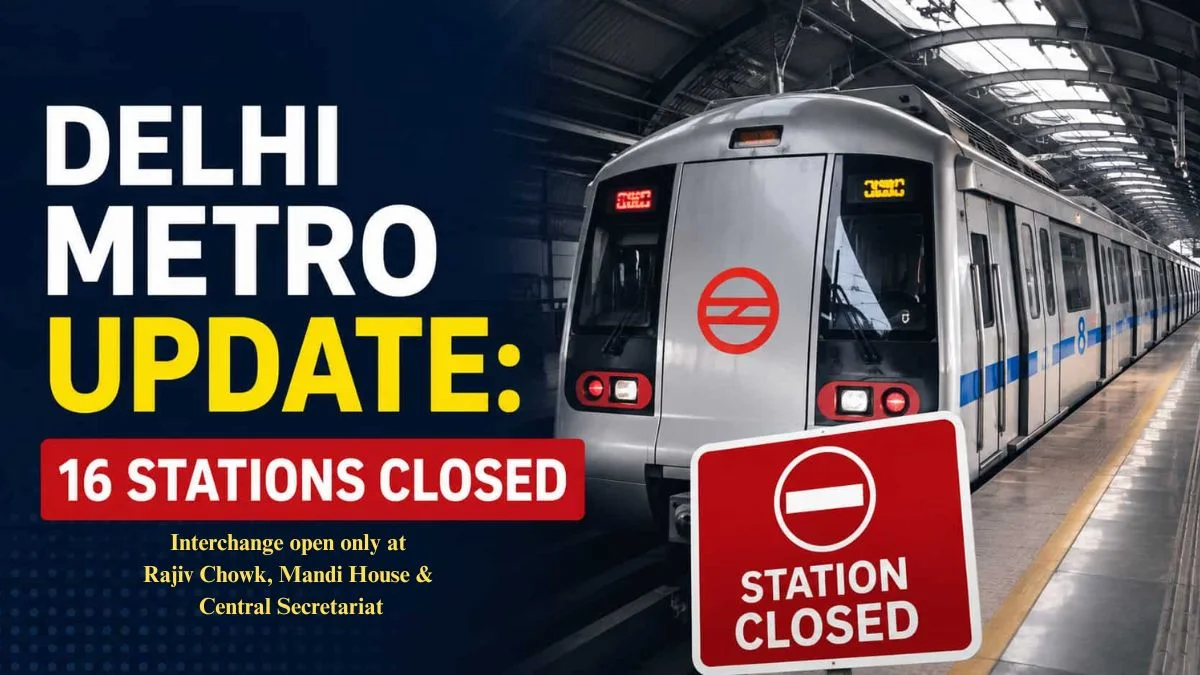
Delhi Metro has temporarily closed 16 metro stations due to security reasons. Check the full station list, alternate routes, interchange details, and travel advisory.
New Delhi: If you are planning to travel through Central Delhi today, be prepared for significant disruptions. The Delhi Metro Rail Corporation (DMRC) has closed entry and exit points at 16 stations across the city, citing security concerns due to ongoing protests in the Jantar Mantar and Parliament areas. While trains continue to operate across the network, access to and from these specific stations has been suspended “until further notice.”
This is not an isolated incident; it is part of a series of stringent security measures implemented by the DMRC and Delhi Police throughout the week as protests have intensified during the Monsoon Session of Parliament. Here is the complete and verified information regarding what is happening, the reasons behind it, and what commuters can do.
Why Are These Metro Stations Closed?
The temporary closure is part of enhanced security arrangements in central Delhi. Security agencies have increased precautions due to ongoing law-and-order concerns, including demonstrations near sensitive government areas during the Monsoon Session of Parliament.
Such preventive measures are common whenever large public gatherings, protests, VIP movements, or national events require additional security around important government locations.
Officials have clarified that the restrictions are precautionary and will remain in place until security agencies review the situation.
Complete List of Closed Delhi Metro Stations
Passengers cannot enter or exit through the following stations:
- Lok Kalyan Marg
- Rajiv Chowk
- Patel Chowk
- Ramakrishna Ashram Marg
- Barakhamba Road
- Supreme Court
- Seva Teerth
- Janpath
- Mandi House
- Central Secretariat
- ITO
- Delhi Gate
- Indraprastha
- Khan Market
- Jor Bagh
- Shivaji Stadium
- Interchange Facilities Still Available
Despite the closure of entry and exit gates, passengers can still change metro lines at the following interchange stations:
- Rajiv Chowk
- Mandi House
- Central Secretariat
This means travellers already inside the metro system can continue their journey by changing trains without exiting these stations.
Are Metro Trains Still Running?
Yes. DMRC has confirmed that metro train services are continuing on all affected corridors.
However, trains will not allow passengers to board or deboard at the closed stations. Those travelling to these destinations should use nearby operational stations and arrange alternate transportation such as buses, auto-rickshaws, taxis, or walking where feasible.
How Security Measures Affect Delhi Metro Operations
Delhi Metro operates one of the country’s busiest rapid transit networks and regularly coordinates with the Central Industrial Security Force (CISF) and Delhi Police to ensure passenger safety.
During periods of heightened security, authorities may introduce several temporary measures, including:
- Station Closures
Entry and exit gates at selected stations may be closed to prevent overcrowding or restrict access to sensitive areas. Train services usually continue to minimise disruption across the network.
- Stricter Security Checks
Passengers may experience longer waiting times due to enhanced baggage screening, frisking, and metal detector checks. Travellers are advised to carry minimal luggage and reach stations earlier than usual.
- Additional Security Personnel
Extra CISF teams, Delhi Police officers, Quick Reaction Teams (QRTs), and surveillance staff are deployed at important stations to manage crowds and respond quickly to emergencies.
- Advanced Surveillance
Delhi Metro uses an extensive CCTV network, baggage scanners, metal detectors, and modern security systems to monitor stations. During high-alert situations, surveillance is intensified to improve public safety.
- Traffic Diversions Around Metro Stations
Security restrictions on surrounding roads may also affect buses, taxis, auto-rickshaws, and private vehicles, leading to increased passenger crowds at nearby operational stations.
Why Does DMRC Take These Steps?
The primary objective is to protect passengers and maintain public safety. Temporary restrictions help security agencies manage large gatherings, prevent unauthorised access to sensitive locations, and ensure that metro operations continue safely.
Similar measures have been implemented in the past during major national celebrations, VIP visits, large demonstrations, and periods of heightened security across the capital.
Travel Advisory for Metro Passengers
If you are planning to travel through central Delhi today, keep these points in mind:
- Check the latest metro updates before leaving home.
- Use nearby operational stations if your destination station is closed.
- Allow extra travel time due to enhanced security screening.
- Follow instructions issued by DMRC, CISF personnel, and Delhi Police.
- Consider alternative modes of transport if travelling to the affected areas.
The temporary closure of 16 Delhi Metro stations is a precautionary security measure and does not affect overall metro train operations. While commuters may face some inconvenience, trains continue to run across the network, and interchange services remain available at Rajiv Chowk, Mandi House, and Central Secretariat.
Passengers are advised to stay informed through official DMRC updates and plan their journeys accordingly until the security advisory is withdrawn.
